CDSHF

Cobourg

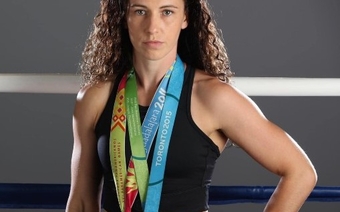
Boxing-Mandy Bujold

Mandy Bujold

Mandy Marie Bujold was born July 25, 1987 in Cobourg to Roger and Brigitte Bujold. She had two older brothers. The family liuved in Port Hope, then moved to Moncton, NB where she spent her youth and then to Kitchener, ON where they settled in 2002.

In Moncton her dad hung a heavy bag for her two brothers to pound away on. Mandy at 10, was drawn to it and was on it all the time. In 2004 Mandy was introduced to the sport of boxing and began training. Her first fight was in 2005 when she won at the Brampton Cup Tournament. In 2006 she won the Canadian Junior boxing title in the 50kg class. 

In 2007 Bujold won the senior Canadian title in the 50 kg class and gold at the American Women’s Continental Championships. In 2008 she made her first appearance at the AIBA Women’s World Championships. She has made almost annual appearances since. Her best result was 2014 when she finished top 8.

Mandy’s career highlight came in 2011 at the Pan American Games when she won gold. It was the first-time women’s boxing was included at that multi-sport competition. In 2013 she was the Canadian Golden Gloves Champion. In 2014 Bujold earned another multi-sport medal when she captured bronze at the Commonwealth Games in Glasgow. That year Mandy finished Top 8 in the International Boxing Association World Championships.

In 2015 Bujold successfully defended her Pan Am Games title and became the first female boxer to win 2 gold medals at the Pan Ams. In March 2016 she earned an Olympic berth with a gold medal win at the American Continental Qualifier. At the Olympics Mandy ranked #2 in the world, made it to the flyweight quarterfinals. She became ill the night before and ended up losing her match. In 2017 she won silver at the Continental Championships.

Bujold took some time to get married and then to have a child in November 2018. The 11-time Canadian champion and Boxer of the Year wanted to earn a berth on the Canadian Team to the Summer Olympics in Tokyo. Boxing Canada wanted her to move to Montreal to train but Mandy didn’t want to be apart from her family. So, she paid for the training costs herself and asked the public for financial support.

Bujold trained hard in preparation for the Olympic qualifiers.  In 2019 she won silver at the International Balkan Tournament. In 2019 she won gold in the 51kg weight class at the Canadian Olympic Qualifier. In early February 2020 at the Bocskai Memorial Tournament at Debrecen, Hungary Mandy earned a bronze. Fifteen years and 165 fights behind her, Mandy needed at least a fourth-place finish to qualify for the 2020 Olympics and become the only Canadian female boxer to earn her way to 2 straight Olympics. And then Covid hit. 

Bujold was prepared to compete at the Americas Olympic Qualifier for the Tokyo 2020 postponed Olympics. Mandy was not included in the world ranking list that would now be used to allocate Olympic quota spots because she had been on maternity leave while the events that would count had been held. Mandy appealed to the Court of Arbitration for Sport, which ruled that any decisions made about Olympic boxing qualification needed to include accommodation for women who were pregnant or postpartum during the qualification period.

And in 2021 at the postponed Tokyo 2020 Olympics Mandy ranked 17th.

During her athletic career she received a number of other awards Including the 2016 KW Citizen of the Year, the Queen’s Diamond Jubilee medal, Oktoberfest Women of the Year (sports category), 2x KW Athlete of the Year, WOW award recipient, and alongside other local VIPs, had “The Golden Bujold” burger named after her by The WORKS Gourmet Burger in Uptown Waterloo.


Updated September 2024
 

Sport Team or Name This Story is about

Add new comment

Restricted HTML

  • Allowed HTML tags: <a href hreflang> <em> <strong> <cite> <blockquote cite> <code> <ul type> <ol start type> <li> <dl> <dt> <dd> <h2 id> <h3 id> <h4 id> <h5 id> <h6 id>
  • Lines and paragraphs break automatically.
  • Web page addresses and email addresses turn into links automatically.
CAPTCHA
This question is for testing whether or not you are a human visitor and to prevent automated spam submissions.

Boxing-Cobourg Boxing Club

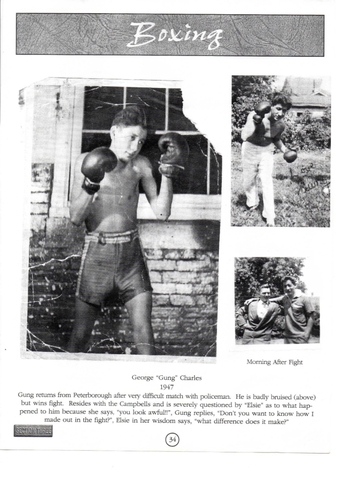
Gung Charles

Amateur Fights Held in Victoria Hall’s Beautiful Opera House!

It may be hard to imagine, but some sixty years ago fight nights were among the entertainment highlights for visitors to Victoria Hall.

One didn't have to look far for an eager audience or even competitors. In the first half of the 20th Century most of the fights took place at the schoolyards in the area. In the 1940’s and 1950’s Mr Craig taught boxing on the top floor of the Sutherland Block. The Sutherland Block was built by John Sutherland, one-time Mayor and Town Clerk. The Customs House was located in Cobourg for many years as was the Smith Junior Ltd, a soda fountain equipment and syrup company and Bastian Brothers. Mr Craig lived and operated a grocery business in Cobourg. His boxing ring had regular matches between locals. The Sutherland block was located at Charles St on the west side of Division St. 

Some of the boxers in the 1950s included Bruce Richardson, Billy McBride and Billy Brisbin. The referees for an October 1952 fight card at the Recreational Center were Timer Fox and Jim Miskelly.

On June 1, 1953 Jim Miskelly held a meeting that led to the formation of the Cobourg Boxing Club. Home became the Market Building south of Victoria Hall. There was a legal sized ring for sparring and training plus speed bags and heavy bags. It was a haven for the young men who had grown up with their dads away at war.

Another boxing team was created and stationed at the Ordinance Depot. Newspaper articles describe boxers fighting at Kingston and Borden.

Cpl Ronnie Headley who was coach of the No 26 C.O.D hockey champs was formerly one of Canada’s outstanding boxers. He was born in Ottawa and started boxing at 14. He turned pro at 19 in 1929. Over the next 6 years he fought 97 times and according to the Ottawa Citizen lost only 2x. In a tour of the British Isles he won 12, lost 1, drew 1. BoxRec records 26 pro welterweight bouts between 1925-1935, 14 wins (4KOs) and 12 losses (4KOs). Headley retired in 1958 to Cobourg.

Emerson Charles and his younger brother, George Charles were among the best of the local fighters. Emerson "Chief" Charles went on to fight professionally out of Patterson, New Jersey, compiling a very respectable record in 1948-1953 of 16 decisions; 8 by knockout, 11 losses, 3 by knockout and 3 draws. He fought a total 121 rounds in 30 professional fights as a middleweight at numerous eastern U.S venues including Madison Square Gardens (2) & St Nicholas Arena (4) in NYC, Coney Island Velodrome in Brooklyn NY and Red Wing Stadium in Rochester NY. In one memorable bout at the Arena in Philadelphia he lost a six-round decision on points to Joey Giardello, then World Welterweight Champ.

While he was still fighting out of Cobourg, local coverage had this to say about one of the “Chief's” matches…“Cobourg's new found pugilistic hero invaded the rings of Peterborough last Thursday night and scalped another victim”

Little has been recorded about George “Gung” Charles’ success in the boxing ring. One quote was “Another Indian chap from Cobourg, George Charles, won a decision. He started like a buzz saw with a two-fisted attack and showed a lovely left. It was a nice fight.”

At the University of Toronto Henry (Hank) Henshall earned the title of Featherweight Boxing Champion for four years. He came to CDCI in 1950 to direct all boy’s athletics. In 1954 he displayed the first symptoms of Muscular Atrophy. He continued to coach and teach, gradually having to cut back. He tried to build a healthy rivalry between West and East schools by organizing CDCI’s first harrier race. 200 runners participated. During the running of the second race in 1962 Henshall died. The race is called Hank’s Harrier. 

******************


IT'S UNANIMOUS
By Layton Dodge
November 20, 1970 Cobourg Sentinel Star

AMATEUR BOXING RETURNED TO Cobourg after a long absence Tuesday night. It was an instant hit. Nearly 200 curious fight fans turned out at Cobourg Pavilion for the seven-bout card promoted by Fred Richardson of the new North-East Athletic Club. They were not disappointed.

The fourteen boxers responded with rousing matches that always made up in action what they may have lacked in finesse. If crowd reaction was the sole judge, the semi-final bout between Cobourg's John Taylor and Toronto's Luis Reed rated the headliner of the evening. Taylor, in only his second fight, became the first North-East AC member to savor victory when he scored a unanimous and popular decision over the fancy-stepping Jamaican.

In his first scrap before his hometown fans, the 167-pound Taylor really won the crowd and the bout when he caught Reed with a booming right uppercut in the second round and knocked the Toronto boxer on the canvas. Following a close opening round, Taylor opened up in the second and controlled the fight thereafter. A flurry of punches by Taylor midway in the second round took most of the starch out of Reed and put him on the defensive. The Cobourg boxer had Reed in trouble again in the third round, staggering him twice with several combinations.

In the main event, 125-pound Tom Bland Jr. of Toronto Pioneer Club earned a unanimous verdict over John Biel of Oshawa. The loser didn't quite belong in Bland's class, although he did show an ability to absorb punishment well. Biel did land several solid blows in the bout but wound up with a bloody nose in return. It marked the second straight win this month for the 23 year old Bland. 

Three other Blands also appeared on the card in preliminaries. Fourteen-year-old Jimmy won a split decision from Curtis Redman Cress, posting his fourth consecutive victory in the process. Albert Bland, 21, dropped a split decision to Joe Rumundi of Toronto in a welterweight bout. David (Spider) Bland was overpowered by 17 year old John Riley of Toronto. 

Riley stopped Bland with a solid right and was awarded a TKO at 1:25 of the first round. Riley, who outweighed his opponent by 11 pounds, is trained by Bill Felstein, brother of Bob "Pretty Boy" Felstein, contender for the Canadian heavyweight championship. "He has a killer instinct," Felstein pointed out after the bout in reference to Riley. "I have to take some of it out of him and teach him how to box. For Riley, who's been lifting weights since he was 12 and looked every bit the part, it was only his second fight. 

Despite a lack of conditioning and training, heavyweight Ralph Miller of Cobourg stepped in against Oshawa's Tom Bouckley and gave an excellent account of himself, even though beaten on a split decision. Lightweights Paul Ferguson and David Quinlin, both of the North-East Athletic Club, flailed away for 3 rounds in another bout. Appropriately, the match ended in a draw. Both boys tired noticeably in the final round.

Cobourg officials for the fights included judge Glen Dafoe, who fought 55 times as an amateur; and old-timer Jack Henning, former Canadian middleweight champion in the 1920s.

*****************************

Moving On
By Layton Dodge
September 12, 1972  Cobourg Sentinel Star

EFFECTIVE TODAY. FRED RICHARDSON is moving his large family and the base of his small North East Athletic Club operations to Oshawa. Father of 11 children and the revival of amateur boxing in this area, Richardson is returning to live in the city where he formerly had a gym and a boxing club on Court Street.

“I’m not moving because I don’t like it here” Richardson emphasized.” It’s the travelling I want to cut down on,” he noted. Fred has been commuting from his residence at RR3 Baltimore to work at General Motors for more than two years. "I'll have my roots in Oshawa but, for sure, I want the boxing club to carry on here," Richardson told the Sentinel-Star on Wednesday. "Whatever I can do to help, I'll do it and there are ways; he said. 

The North East AC will be continued in Oshawa. Richardson expects to have a gym in Oshawa and to join forces with the Oshawa club's Ron Cyr with whom he's been closely associated in the past anyway. Heavyweight Ralph Miller, who has been an active member of the North East AC almost from inception more than two years ago, is expected to travel once a week to Oshawa for sparring sessions. So is Roy Sanders, a middleweight.

The two boxers, who'll likely work out here on their own, could be joined by Danny Washburn. In any event, Richardson intends to use the Cobourg district fighters in his monthly boxing promotions in Oshawa starting October 17.

The switch to Oshawa will be yet another stop for the North East AC. It's operated at one time or another out of Fenella, the Lions Scout Hall in Cobourg and out of Richardson's basement where he had his own home-built ring and bags set up.

Boxing never really caught on here in a big way. Many boys and young men tried the sport but few stayed at it for long. It's a game requiring mental and physical toughness only a minority care to bear. Richardson was disappointed that fine prospects like John Taylor and Mike Boyle didn't pursue boxing further but he never became overly discouraged. He always maintained that the number of boxers who trained with him was higher than in most centres of comparable size.

Richardson promoted several shows here. Only the first at the Pavilion and the one held at Cobourg Arena in May of 1971 could be termed successful at the box office. He took a financial bath in his latest endeavor this summer.

"Oshawa and the North East AC will work as a unit, especially in promotions and in training together at least once a week” assured the ring veteran who's been connected with the fight game for nearly 14 years. "You probably haven't heard the last of me," Richardson exclaimed. "I'll come back, I hope, and it's only a hope at the moment, to promote a show here before Christmas."

***************************

DAN WASHBURN FIGHT

Danny Washburn of the North East Athletic Club will climb through the ropes for his second amateur fight next Monday night on a boxing card in Toronto. The 16,year old CDCI East student, who lives at RR1 Castleton, will trade punches with Glenn (Rocky) Broadley of the Clairlea Boxing Club. Both boys have just one bout under their belt, so neither will have any edge in ring experience. Washburn will carry 118 pounds on his 5 foot 5 frame into the match. Danny will weigh in lighter than for his previous bout in which he battled back in the third round to earn a draw with his Toronto opponent. While acknowledging the fact that he's dropped almost 12 pounds in recent months, Washburn feels the weight loss has not sapped his strength. 

Washburn almost gave up the sport before he engaged in his first scrap. He trained under Fred Richardson for quite a spell but then stopped. Richardson talked him into turning out to train again at a Centreton ball game this summer and later lined up his first fight for him. "He has the makings of a boxer, no two ways about it," Richardson said of Washburn this week. "Danny has the guts. He will mix it up and he will train. It remains to be seen whether he has the stick-to-it power."
 

Updated August 2020


Sport Team or Name This Story is about

Comments

Permalink

Great to read about the Cobourg Boxing Club and some of the club's history. You missed one LOL. Billy Gilpin won the Western Ontario title in Bramalea. He went on to fight in the All Ontario Amateur Boxing meet and went to the final. He lost by decision. A number of write-ups about his boxing escapades were written by Layton Dodge. Fred Richardson taught me how to throw a punch with my left hand. Came in handy!

Add new comment

Restricted HTML

  • Allowed HTML tags: <a href hreflang> <em> <strong> <cite> <blockquote cite> <code> <ul type> <ol start type> <li> <dl> <dt> <dd> <h2 id> <h3 id> <h4 id> <h5 id> <h6 id>
  • Lines and paragraphs break automatically.
  • Web page addresses and email addresses turn into links automatically.
CAPTCHA
This question is for testing whether or not you are a human visitor and to prevent automated spam submissions.

School-St Mary's CSS Athletics

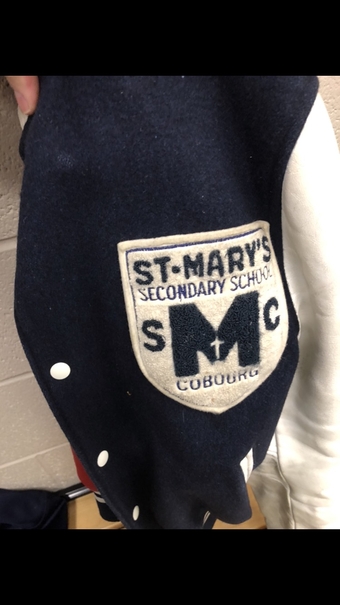
St Mary's School jacket

School-St Mary's CSS First 3 Sports

Swim Team
In 1984, St. Mary’s Secondary School (SMCSS) began.  The building located at 760 Burnham St., Cobourg, housed students from Grade 1 – 9.  There were 14 Grade 9 students in the first year.  It was difficult to run any sport teams for the Grade 9’s.   

In 1985, St. Mary’s swim team started.  We practiced every week, Monday, Wednesday and Friday at 7 am during the Fall at the local YMCA.  We had all levels of swimmers on the team.  The only requirement was attendance.  

There were students from Campbellford that were interested in joining but had no way of getting to the practices that early.   After speaking to the Director of Education, Don Folz, he agreed to provide a bus for the interested students on Mondays and Wednesdays.  

The swim team had many successful years and fortunately is still thriving today.  We have attended OFSAA every year since the team’s inception.   

Cross-Country Team
St. Mary’s Cross-Country team began in 1987.  As we didn’t have a track or any running facilities, training consisted of running through the local neighbourhood.  We practiced Tuesday, Wednesday and Thursday after school.  We only had a handful of students interested in competing on the Cross-Country team.  

We were always at a disadvantage in terms of competition with other Secondary Schools given our lack of facilities.  Our “creative” practices didn’t always glean the results we were hoping for.  However, our students never gave up and always worked hard and gave it their all. 

There was one student, however, who was a natural long-distance runner.  Sarah Johnston worked diligently and qualified at Kawartha to move on to COSSA.  The highlight for Sarah was being able to compete at OFSAA in Cambridge, Ontario. 

Track and Field Team
St. Mary’s Track and Field team started in 1987.  Facing the same disadvantages as the Cross-Country team, we made do with the facilities that we had.  We were able to practice the field events, such as javelin, disc, high jump and long jump on our driveway and small outfield.  The long-distance running athletes ran through the neighbourhood while the short distance runners, hurdlers and relay teams practiced on the small paved area around the school.  Wind sprints up the small hill at the side of the school helped with the cardio portion of the practice.   Practices were held 4 nights a week, with all students being welcomed as long as there was a commitment to attend all practices.   

We were fortunate to have a sprinter, Tony Raymond, qualify at Kawartha and then win gold medals at COSSA in both the 100 and 200 metre races.  Those wins allowed him to compete at OFSAA at York University.

***********************************************************************

School-St Mary's CSS Athletic Firsts

St. Mary’s CSS Thunder - Firsts during 35 Yr Growth of Athletic Department

1984      St. Mary’s Catholic Secondary School (SMCSS) opens its doors.
1985/86 The first athletes compete for the school in Swimming, Cross-Country and Track & Field.  A small handful of students.
1986      The first year of organized sports teams competing in Kawartha Athletics as the St. Mary’s Marauders.
1988      The beginnings of Track, Basketball, Badminton, Soccer, Tennis, Weightlifting and Girls Softball
1989      The beginnings of Wrestling, Weightlifting, J/S Boys Soccer, J/S Girls Basketball, M/J Boys Basketball, M/J Girls Volleyball, M Boys Volleyball, Cross-country, Badminton, Boys Hockey, Girls Softball, Girls Soccer, Tennis, Swimming 
1990      Name changed from Marauders to THUNDER
1990      The beginnings of Track, M/S Boys Basketball, M/J Girls Basketball, J/S Badminton, Tennis, Weightlifting, M/J/S Girls Volleyball, M/J Boys Volleyball, Mixed Softball, Swimming, J Girls Soccer, J Boys Soccer
1991      The beginnings of Cross-country, Track, M/J Boys Basketball, M/S Girls Basketball, M/J/S Girls Volleyball, M/J Boys Volleyball, Mixed Softball, Tennis, Badminton, Weight Training, Boys Rugby, J/S Girls Soccer, J/S Boys Soccer, Swimming, Boys Hockey
1991      The first Kawartha Championship.  Midget Boys Basketball.
1992      The first sports tour at St. Mary’s.  Boys Hockey competed in the Irish Rover Tournament at the University of Notre Dame in South Bend, Indiana.
The beginnings of J/S Girls Soccer, J/S Boys Soccer, Boys Hockey, Mixed Softball, M/J/S Girls Basketball, M/J Boys Basketball (KAWARTHA CHAMPS), S Boys Volleyball (KAWARTHA CHAMPS), M/J/S Girls Volleyball, Tennis, Badminton, Boys Rugby, Swimming
1995      Girls Rugby begins.
1997      Golf begins.
1999      Girls Hockey begins.
1999      The First COSSA Championships are won.  Junior Girls Soccer AND Senior Girls Rugby
2002      The first OFSAA Medal is won.  Brian Hamilton wins Silver in the 400m Hurdles in Track & Field.
2004      Boys Football begins.
2007      The First OFSAA Individual Champion – James Nearing wins Tennis Singles.
2010      Ultimate Frisbee begins.
2011       Floorball begins.
2012      The First Repeat OFSAA Individual Champion – Kristina Steins wins the 100m Backstroke.  She won the same event in 2010.  She also became the first athlete to win multiple OFSAA medals.
2012      St. Mary’s hosts its first OFSAA Championships – Boys A/AA Rugby.
2015      Boys Baseball begins.
2016      The First OFSAA Team Medal – Boys Golf win Bronze.
2018      The First OFSAA Team Champion – Boys Rugby.
2019      The First OFSAA Repeat Team Champion – Boys Rugby.

****************************************


School-St. Mary’s CSS Early Athletics

The Turning Point of Early Success

I began my teaching/coaching career at St Mary’s Catholic Secondary School (SMCSS) in 1989. It was a small populated school of about 200 students. We were trying to establish publicly funded Catholic education. Prior to that my philosophies were forged in an environment of very competitive and successful athletic endeavors. In spite of the successes the common theme were values driven programs.

So, when I came to SMCSS that is what I attempted to offer. It was not easy in the beginning, where my philosophy was a bit in conflict with the current situation. I demanded a strong commitment to excellence through 'Education through Sport". I perpetuated a motto of, 'No School, No Sports, No Practice, No Play."

This demand was not readily accepted and only a few student/athletes could commit to the dedication that was required. The first sports that I developed using these demands were Basketball and Volleyball. Among the core student athletes that forged the legacy of "It's a Thunder Thing" for the next five years of arduous pursuits in these two core sports were Jason Craig, Eric O'Rourke, Mike Bons, Gary Collins, Bryan Brady, Andrew Ross and Michael Smith.

What became pivotal to our successes was when we were able to convert the small 60 foot by 30 foot gym (volleyball court dimensions) from a cafeteria at lunch to a practice facility. The core athletes practiced every lunch hour the various pursuits for five years. Practices were all closed because I felt that practice was not a spectator sport. Student/athletes need to be in a learning environment free to make mistakes and learn.

Of course, there was some resistance from the administration because of the optics of an elite program. However, with the incorporation of a House System for inter mural sports that was more inclusive, the administration softened and we proceeded.

I also coached a group of female/student athletes for 3 years with the same tenacity demands. They were highly committed and wanted to emulate what the boys were doing.  These athletes included Cynthia Jurchison, Amy O’Rourke, Rachel King, Melissa Bonner, Jennifer Burleigh, Denise McDonald and Lola Teelucksingh.  I tried to develop programs instead of just having teams.

We were fortunate at SMCSS, because we had a stable of teacher/coaches who committed themselves to kids and spent many hours away from their families to spend time with other people's families. Even during the 'Strike Year' I was able to conduct coaching courses where similar perspectives to inter school sports were formulated.

Our teachers did not want to sanction no coaching and we were prepared to start up our own "Catholic League" so we could continue to participate and compete at an inter school level. Some of the trail blazers who led many fine programs at SMCSS during the early years were, Steve Egan, Stan Muldoon, Donna Conway, Jane Anne Egan, Rick Seggie, Jim Blainey, Ray Heffernan, John McDougall, Mike Desjardins and Mike Killoran.

By Rob Majdell
Former Teacher, Coach, Athletic Director, Principal


Sport Team or Name This Story is about

Add new comment

Restricted HTML

  • Allowed HTML tags: <a href hreflang> <em> <strong> <cite> <blockquote cite> <code> <ul type> <ol start type> <li> <dl> <dt> <dd> <h2 id> <h3 id> <h4 id> <h5 id> <h6 id>
  • Lines and paragraphs break automatically.
  • Web page addresses and email addresses turn into links automatically.
CAPTCHA
This question is for testing whether or not you are a human visitor and to prevent automated spam submissions.

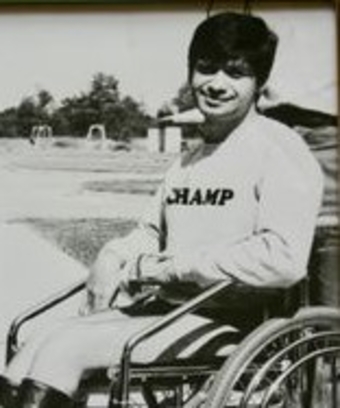
Wheelchair Racing-Frank Mazza

Mazza

Frank was born April 7th 1958 at St. Joseph’s Hospital in Peterborough Ontario. His parents, Frank and Maria, were ecstatic about the arrival of a beautiful baby boy. He would be the third child in his loving family. His sisters Anna Maria and Pia were extremely happy to have a new addition to the family.

Frank was a very quiet, adorable baby, who needed more care and attention while at home. Everyone assisted his mother at the time. Frank was very “Special” to the family. He was included and encouraged to participate in many activities with the neighborhood children. He also played with his sisters. He would laugh with anticipation and excitement whenever company was around.

Frank’s participation in the Special Olympics has brought his family pride and joy. His facial expressions displayed his indomitable spirit throughout competitions. His many gold medals attest to his strong and determined character.

Dino, the youngest has been his “Best Buddy”. The rapport the two brothers share is indescribable. Their bond is truly exceptional. 

Frank’s 60th birthday brought a reflection of happiness to his family. His parents would express their love and appreciation to everyone involved in his care.

Frank has Cerebral Palsy (CP) which affects his body movement, muscle control, muscle coordination, muscle tone, reflex, posture and balance. It also has impact on his fine motor skills, gross motor skills and oral motor functioning. Cerebral Palsy’s effect on functional abilities varies greatly. Many affected people can walk while others, like Frank, use wheelchairs.

Frank’s CP affects three of his limbs, both legs and right arm. His mobility is purely via a one-armed wheelchair to move around. He uses his left arm only to propel his wheelchair.

In the early 1980s, Frank started wheelchair racing as a recreational activity. He competed in the Eastern Ontario CP Games and to his surprise, he won most of the events in which he competed. He then went to the Ontario CP Games, where he continued to roll up the wins. Frank continued winning both at the Regional and Provincial games.

Frank was using his everyday chair to race in, which certainly placed him at a disadvantage, since most racers had specially made racing wheelchairs. They could also propel them with two arms.

Frank was classified as a CP3, which meant racers had three limbs affected. Where Frank could only wheel with one arm, his competitors all wheeled with two arms (one of their arms would be mildly affected by CP, but they were still capable of using both arms to wheel).

Unfortunately, records at this time were not recorded on computers. The Ontario CP Sports Association has some partial results. Frank has a scrapbook of newspaper clippings with his results at provincial and international meets. He has an extensive collection of medals trophies and plaques won while completing across North America and in Belgium. Douglas Wilton, the head coach/manager of the Canadian CP team, can confirm these results.

As a result of his success, Frank was invited to try out for the Canadian CP National Team. He attended their training camp in Windsor in 1983. Team coaches stated Frank needed enhanced training plus a racing wheelchair to compete at the next level in the Olympics and the World Games.

In consultation with his local coach, Frank decided he wanted to complete at the next level. This meant training would ramp up. As well, he needed to find someone to design and build a one-arm racing wheelchair, as there was none – zero – available anywhere.

It was at this point two significant changes happened for Frank:
One – Training: A two-year training program was designed by Team Canada coaches specifically for Frank and his local coach to carry out. The goal was for Frank to peak at the 1984 Olympics for the International Games for the Physically Disabled (later called Paralympics). His training was ramped up to three weight training sessions per week plus three track sessions per week. 

The training became progressively harder, and Frank met all the targets and challenges. This training was not easy, and during the winter they drove 45 minutes each way to an indoor track for training three days a week. It was a big commitment. After 1984 Frank took a short break from training, then back to another two-year program to peak again for the 1986 Cerebral Palsy Work Championship Games.

As all high-level athletes know, years of training six days a week can be an incredible grind. Add to that the fatigue of the travel for training and meets for an individual in a wheelchair. Three winter nights each week, Frank got picked up at 6:30 p.m. to drive 45 minutes to an indoor track for his training session. This involved a warm-up, stretching, that night’s track routine, cool down and back into a cold car for another 45-minute ride home. All these years of weight and track training made him tough to beat, and revealed Frank’s character.

Two – Get a Racing Wheelchair: Frank initially raced in his everyday Everest and Jennings wheelchair. A new Everest and Jennings chair was purchased and modified which resulted in Frank’s times improving. Frank received a lot of acknowledgment and praise from competitors and coaches from around the world for being able to compete at the World level without a racing chair. 

Frank’s competitors were all wheeling with two arms using the latest technology in racing chairs. We could not get a wheelchair maker or a university engineering department or a machine shop to make one. Much effort was put into finding someone who could design and make a one-armed racing wheelchair.

Then in 1985 we met an Ontario wheelchair racer who had made his own chair. This wonderful man worked diligently with us to make a one-armed racing chair for Frank. It was one of the first one-arm racing chair to be made on the planet. This was the final piece in Frank’s puzzle for success. As a one-armed racer, Frank was bucking the odds, but now he was finally on a more even playing field with the technology.

Ms Suzanne Atkinson, a regional newspaper reporter, was actively following Frank’s success and wrote about his incredible journey. Her coverage resulted in many groups and individuals in the community generously donating money to purchase this chair and cover some of the expenses.

As Doug Wilton, the Canadian head coach/manager, said, “Frank is the greatest one-armed wheeler in the world, always competing against 2-armed wheelers.”

Frank’s local coach often commented that, “Frank’s accomplishments and success can only be truly appreciated by those who saw him race or competed against him. With his extreme competitive nature, Frank is truly a courageous Olympian.”

ACCOMPLISHMENTS AND AWARDS

Represented Canada internationally from 1983-1986
June 1984- Olympic Year – International Games for the Disabled (now called the Paralympics)
4x 100 metre relay race (World Record 101 seconds) Gold Medal
60 metre sprint – 6th
200 metre sprint – 10th (disqualified for a lane violation in his heat)

1984 CP Provincial Games
60 metre sprint – gold (new record)
100 metre sprint – gold (new record)
200 metre sprint – gold (new record)
400 metre sprint – gold
Shotput - bronze

1985 Michigan State Championships for the Physically Disabled
60 metre sprint – gold
200 metre sprint – gold
400 metre sprint – gold
4x100 metre relay race – gold

1986 Cerebral Palsy World Championship Games – Gits, Belgium
4x100 metre relay race – gold
400 metre sprint – silver
100 metre sprint – bronze
Team Canada won the overall Medal count with 42 Gold Medals, 16 Silver Medals and 12 Bronze Medals

1982
Presented with a Championship Certificate from the Province of Ontario in recognition of being a Provincial Champion in the field of amateur sport

1984
Presented with a Sports Jacket emblazed with a crest of the Town of Cobourg and the Bicentennial flag from the Mayor of Cobourg and the Chamber of Commerce
Presented with an Ontario Championship Certificate from the Province of Ontario
Presented with an Achievement Award Certificate from the Province of Ontario for distinguished performance in the field of amateur sport

1985
Presented with a Certificate of International Achievement from Premier David Peterson, at the Ontario Provincial Amateur Sports Banquet

1986
Presented with a Certificate of World Achievement from Premier David Peterson, at the 20th Annual Sports Awards Banquet in recognition of distinguished performance in the field of amateur sport

1987
Presented with a Civic Award from the City of Peterborough
Presented with an International Achievement Award from the Premier of Ontario

1990
Inducted into the Ontario CP Sports Athletes “Hall of Fame”

2019
Inducted into the Cobourg and District Sports Hall of Fame

Sources: Suzanne Atkinson, reporter
   Doug Montgomery, Frank Mazza’s local coach
   Doug Wilton, Head Coach and Team Manager for Canada’s National Cerebral Palsy team (1979-2000)

 
Reviewed August 2020
Sport Team or Name This Story is about

Add new comment

Restricted HTML

  • Allowed HTML tags: <a href hreflang> <em> <strong> <cite> <blockquote cite> <code> <ul type> <ol start type> <li> <dl> <dt> <dd> <h2 id> <h3 id> <h4 id> <h5 id> <h6 id>
  • Lines and paragraphs break automatically.
  • Web page addresses and email addresses turn into links automatically.
CAPTCHA
This question is for testing whether or not you are a human visitor and to prevent automated spam submissions.

Facilities-Recreation: Indoor

CCC


With athletics being a big part of this area’s heritage, facilities have developed significantly over the years.

In Cobourg, it is challenging to determine where the first hockey games were played, but it is assumed that they must have been played on the frozen ponds in the area. The first rink in Cobourg is believed to have been located at the site of the old jail, on the corner of Third and Albert Streets, from 1904-1906. In 1906, it was demolished so that the Cobourg Jail could be built. During the demolition process, part of the building collapsed and a Mr. Edward Terry was killed. 


Another rink, the Corktown Quarry Rink, was established in 1938 on Water Street, in Corktown. It was on the site of a former dump and when the quarry closed, the rink was established. In 1942, a wooden building on the North side of University Avenue West, between Division and George Streets, became the Ley Brothers Arena. However, in February of 1945 the building was damaged by heavy snowfall and was deemed unsafe for use. In 1947, the Town of Cobourg held a referendum on whether to build a new “Memorial Rink”. Apparently, the referendum passed because construction on Furnace Street began in August of 1949. 

The first game in the new facility was played on January 10, 1950. The new building burned down on August 17, 1953, exactly four years after construction began. It was quickly rebuilt and was re-opened on February 20, 1954. Due to the community’s high demand for ice, the “Jack Heenan Arena” (Pad 2) was built behind Memorial Arena and was officially opened on April 1, 1977. Jack Heenan had been the Mayor of Cobourg from 1961-1980. 

In the spring of 2011, with the opening of the new Cobourg Community Centre, the West Northumberland Curling Club (WNCC) signed a long-term contract with the Town of Cobourg to lease the Jack Heenan Arena. The WNCC is a 5-sheet facility which offers curling to all community groups. 

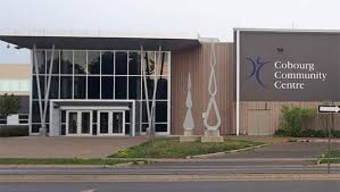
The Cobourg Community Centre opened in 2011, at a cost of approximately $27 million, and provides 2 ice surfaces (the Bowl & the Pond) and gym space for a wide variety of community sports and activities. It also has a running track surrounding the top of the Bowl and many rooms for small group activities/clubs.

The Rotary Waterfront Rink, with its own warm room and restrooms, was opened in 2008 and provides space for free recreational skating during the winter months. Memorial Arena was closed by the Town of Cobourg in August of 2019.

In Haldimand Township, hockey was popular by 1895 and many outdoor rinks were used for play. The first covered rink was in a building where the Catholic cemetery is now located, just south of the intersection of Aird St. and Lyle St., on the east side of the street, in Grafton. Five years later, it was closed and dismantled and residents returned to playing on the areas' frozen ponds and streams. Hockey boomed after WW1 and two more rinks were built in the 1930’s, but both were gone by the outbreak of WW2. The old sheds of St Andrew’s United Church were converted to a covered arena and flooded prior to WW2. 

The current Haldimand Memorial Community Arena was completed in 1949 and officially opened in 1950. It is located west of St. George’s Anglican Church, in Grafton, on County Road #2. Surrounding the arena is a park that originally had 5 ball diamonds. However, in 2018, diamond 5 (the SW diamond) was converted to a children’s playground. 

The Baltimore Community Centre is situated on 27 acres of park land, located on Community Centre Road, in Baltimore. The facility includes one ice surface with 6 dressing rooms, indoor turf sports field, banquet hall/kitchen, four ball diamonds, outdoor multi-purpose court, outdoor pickle ball court, two volleyball courts, 1.3 km paved walking trail and a picnic shelter. 

Prior to 2006, the Baltimore Community Centre, constructed in 1978, consisted of a 2-level building with a hall, stage and bar upstairs and a small seating area, full commercial kitchen (operated by the Baltimore Women’s Institute), and a 2 lane bowling alley downstairs. The arena (current Sabic Arena/turf sports field) was a separate building on the site. It had been a Wintario funded project and further fundraising was required from Baltimore residents. The fundraising committee consisted of Norm Gray (chair), Eleanor Tryon (secretary), Bernice Bell, Marion Sherwin, Lloyd Baxter, Neil Cane, Howard Toyne, Ron Willis, and John Wood.

When the new facility was built, in 2006, it had two ice surfaces (the smaller Sabic Arena and the larger Lion’s Arena). In 2014 turf was installed in the Sabic Arena which was converted into an indoor turf sports field. The main ice surface is NHL size and has the capacity for more than 800 spectators. 

The Bewdley Community Centre is located at 7060 Lake St., in Bewdley. The facility includes one ice surface, banquet hall/kitchen, community library, an outdoor multi-purpose court, and a ball diamond. The Bewdley Community Centre was formerly called the Vincent Massey Memorial Centre, named after Charles Vincent Massey who was a Canadian lawyer and diplomat. He was the 18th Governor General of Canada, and the first Governor General who was actually born in Canada. He retired to Batterwood House in the village of Canton, which is located near Bewdley. 

The land the facility is on was originally purchased in the late 1960’s for the purpose of building a school but it was sold in 1975 to Hamilton Township for the Vincent Massey Memorial Arena. It was constructed in 1975 as a joint venture between Hamilton Township and the former Hope Township. This was a Wintario project that included fundraising from the community. In 2009, the arena was renovated to include the new hall and library and Hamilton Township took over full responsibility of the facility from Port Hope (the former Hope Township) and at that time the name was changed to Bewdley Community Centre.

In Colborne, residents recall skating at Teal’s Pond, on Parliament Street, in the 1940’s. Discussions of building an arena began in 1964. Fundraising took place and the arena was built at the site of an old train station. It was first used in 1965 on natural ice, on a sand base, with no seating, not even benches - just the ice with sand on both sides. The arena wasn’t fully completed until 1967 when they received a Centennial Grant for artificial ice. 

The initial cost was only $35,000 because the land was donated and much of the labour was done by volunteers. The dressing rooms were tiny and a short time later larger dressing rooms were added to the outside of the building. Over the years, many renovations were done. The arena had wooden rafters and over the years dry rot resulted due to condensation. Annual inspections were required and in 1999 it was deemed the building would be condemned by 2001. 

Colborne and Cramahe councils joined forces in 1999 and started a committee to spearhead the construction of a new arena. Committee members included interested citizens as well as some members of Cramahe and Colborne councils and staff. The committee split into 2 groups: fundraising and building. The building committee had to find land, arrange for its’ purchase, and spearhead engineer drawings for the new arena so fundraising goals could be set. 

Fifty-six acres of land, where the Keeler Centre now sits, was purchased for about $250,000. Eleven acres were severed for the arena and the other forty-five acres were developed by the town into a residential subdivision. This property was originally called the “Fairgrounds” and had a racetrack on it. The Keeler Centre cost approximately 3.5 million dollars, including the cost of the land. No grant money was received so they had to take a loan, which has been fully paid off in recent years. Submissions were made from the public (contest with prize) for the naming of the arena and the winner was “The Keeler Centre”, submitted by Marion Miller, named after the founder of the village, Joseph Abbott Keeler. 

The Keeler Centre opened in September of 2001 with an official opening ceremony. It is a multi-purpose facility with an ice pad and hall. Rotary Hall is equipped with a full kitchen, has a stage and complete sound system, and can accommodate up to 250 people. The Keeler Centre also has a large outdoor space – fields with electrical panels which benefits outdoor events. 

The Alnwick Civic Centre is located at 9059 Country Road 45, in Roseneath. This Community Centre is perfect for large or small events, with a 400-person auditorium and a smaller 70-person community room. They are used for hosting a variety of events. The building also houses the fire department and local public library. It was opened on February 29, 1980, at a cost of $403,000 and was funded primarily through the Ministry of Housing, the Ministry of Culture and Recreation, a Wintario Grant, and generous donations from Mr. Jack VanHerwerden and Mr. Peter Feddema. The land was donated by the Roseneath Agricultural Society. 

Originally, it was used for recreational activities but currently is used mainly for civic and social events. The official opening ceremonies were held on June 2, 1980, and included children planting trees which had been donated by Mr. Rapsy. A dinner followed. (Roseneath Women’s Institute: Tweedsmuir History, Mothersill Printing Inc., 1981)

There are many other specialized indoor facilities in the region that house activities such as curling, dance, gymnastics, martial arts, bowling, fitness centres, etc. 

Updated August 2020

Add new comment

Restricted HTML

  • Allowed HTML tags: <a href hreflang> <em> <strong> <cite> <blockquote cite> <code> <ul type> <ol start type> <li> <dl> <dt> <dd> <h2 id> <h3 id> <h4 id> <h5 id> <h6 id>
  • Lines and paragraphs break automatically.
  • Web page addresses and email addresses turn into links automatically.
CAPTCHA
This question is for testing whether or not you are a human visitor and to prevent automated spam submissions.

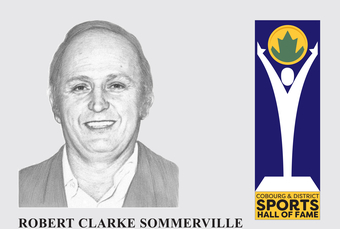
ROBERT CLARKE SOMMERVILLE

ROBERT CLARKE SOMMERVILLE

Robert Clarke Sommerville was born in Toronto, on December 5, 1930. Playing hockey in his early life, he worked his way up to the Junior A ranks, spending 4 years as a goaltender for the Galt Black Hawks. The following two years were spent in the American Hockey League, playing with Philadelphia and Washington.

In 1952, Clarke purchased a small retail business in Cobourg that evolved into Sommerville’s Sporting Goods. Upon arrival, he got involved in the local sports community. He played for the Intermediate hockey team, joined the golf club, pitched in the Town Softball League and joined the executive of the Cobourg Church Hockey League. Quietly, and with a small group of other local sportminded men, a lacrosse league for kids was formed, which operated out of Cobourg’s Memorial Arena. In the mid 1960’s, Clarke, Dick Robinson, Jeff Rolph and Layton Dodge were instrumental in starting and funding a local Junior “B” hockey team, the Cobourg Cougars. Clarke was a Cobourg Cougars’ lifetime executive member. He served in many roles with the team, including General Manager. Clarke was also involved with minor softball.

In 1972, Clarke and his son David coached their “Sinclair  Mustangs” to an Ontario Softball Championship. The sporting goods store was a gathering spot for people to discuss current issues. Many important decisions about local sports were made around the store’s famous pop cooler. Clarke was proud and humbled to be involved in the successes of the Cobourg Cougars, the Cold Springs Cats and countless other local teams and organizations.

Throughout the decades, Sommerville’s Sporting Goods has been a staunch supporter of many sports and athletes in various ways behind the scenes. His support of athletes was truly profound.Clarke Sommerville was a good athlete but his true legacy is as a builder of sport. His contributions will have an everlasting impact on our community.

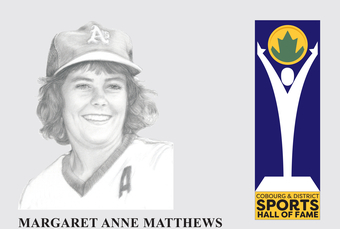
MARGARET ANNE MATTHEWS

MARGARET ANNE MATTHEWS

Margaret Anne Matthews was born on May 15, 1960, in Cobourg. From a very young age, Margie was an abundantly talented, multi-sport athlete who consistently demonstrated exceptional leadership. Her enthusiasm was contagious.

She was very skilled, was the ultimate team leader, and always gave 100%. Margie burst onto the provincial softball stage at the age of 12 when she played for David and Clarke Sommerville’s “Sinclair Mustangs”. They captured the Ontario Novice Championship in 1972. At 14, Margie Matthews joined Paul Currelly’s Cobourg Angels softball Juvenile team and competed against players that were 18 and 19 years of age.

While playing with the Angels, she won 2 more Ontario titles at the Junior ‘B’ level in 1975 and 1976. Paul Currelly remarked that, “When you are talking about Margie, you are talking about one of the best juvenile ball players, anywhere. Her desire and hustle keep the entire team moving.” Margie Matthews won 7 Ontario Softball Championships in her career. While attending high school at CDCI West, from 1974-79, Margie was a multisport outstanding athlete. In 1978, she was voted Most Valuable Player of both the basketball and volleyball teams, received a coaching award and was selected as Cobourg District Collegiate Institute West’s Athlete of the Year.

Margie was also named Cobourg’s Athlete of the Year. In 1979, the West dedicated an award in recognition of her contributions - the “Matthews Award” for performance and leadership. Margie continues to display exceptional athletic skills as a golfer. In 2004 and 2011, she was a member of Team Ontario. Both teams went on to win the Canadian Inter-provincial Golf titles at their respective national golf championships. She has won 18 club championships, 16 championships at the Stratford Country Club and 2 titles at Woodstock's Craigowan Golf Club.

As a member of the Ontario Women’s Amateur golf team in 2004, Margie won the Canadian Championship. In 2009, she won the Golf Ontario Women’s Mid-Am title with scores of 73-75-69. Margaret Anne Matthews, one of Cobourg’s best-ever all-round athletes.

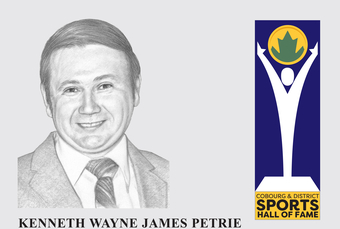
KENNETH WAYNE JAMES PETRIE

KENNETH WAYNE JAMES PETRIE

Kenneth Wayne James Petrie was born in Stratford, Ontario, July 11, 1946. He moved to Cobourg in 1957, with his family. Ken unselfishly devoted much of his adult life to minor sports in Cobourg. These included the Cobourg Church Hockey League, the Legion Minor Softball Association and the Cobourg Baseball Association. At the age of 19, he was recruited by Layton Dodge to volunteer with the Cobourg Church Hockey League (CCHL) as an assistant coach. This began a lifelong tenure with the organization until they moved to the Cobourg Community Centre, in 2011.

Ken was a tireless worker acting as a coach, manager, trainer, fundraiser, bingo volunteer, executive member, committee member or just helping out wherever he could. Ken Petrie was the President of the Cobourg Church Hockey League a record 11 times and was named a Life Member. It is on record that Layton Dodge called Ken, “The driving force behind the CCHL”. Ken Petrie lived the CCHL motto, “Dedicated to our Youth”. Since the mid 1960’s, Ken’s teams had an amazing list of championships, claiming 10 provincial titles in minor sports. In 1967, Ken, along with Tom Savage, coached the Legion squirt Red Wings team to a provincial championship. It was Cobourg Legion Minor Softball’s first ever Provincial title.

Over Ken Petrie’s 50 plus years of volunteerism in Cobourg’s minor sports community, he was recognized with many certificates, citations, plaques and awards for service to his community. One of Ken’s associates noted that you didn’t mind helping him as he never asked anyone to do anything he wouldn’t do himself. Along with Ken's other achievements he found time to umpire, referee, timekeep and organize numerous tournaments. He was also involved in Provincial Women's Softball and coached several local Girls softball teams over the years. Ken was a quiet man who did his talking through his actions and no one did it better. Ken Petrie was a very special
volunteer and a true sportsman.

Sport Played That Connects To Collection List

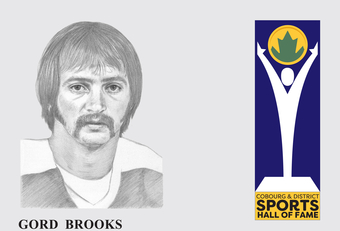
GORD BROOKS

GORD BROOKS

Gord Brooks was born in Cobourg on September 11, 1950 and has the distinction of being Cobourg’s first National Hockey League player. He played his minor hockey with the Cobourg Church Hockey League and spent the 1967- 68 season with Cobourg’s Junior ‘B’ Cougars where he collected 21 goals, 26
assists and 44 minutes in penalties.

Gord played his major Junior ‘A’ years with the Hamilton Red Wings and the London Knights. At the end of the 1969-70 season, Gord Brooks was drafted 51st overall by the St. Louis Blues and spent his first professional season with their farm team, the Kansas City Blues.

From 1971 to 1975, Gordie played 70 National Hockey League games with both the St. Louis Blues and the Washington Capitals. From 1975 to 1980, he played in the North American Hockey League and the American Hockey League where he truly made a name for himself. He played for both the Philadelphia Firebirds and Syracuse Firebirds, averaging 93 points a season for a total of 464. In 1977, his team won the Lockhart Cup as American Hockey League champions.

In 1978, Gord won the John B. Sollenberger trophy as the American Hockey League’s scoring champion and was named to the League’s first All-star team. In 1980, he played part of a season in Klagenfurt, Austria until a knee injury forced him out.

The next year he joined the Saginaw Gears winning an international league championship. Two years after retiring as a pro, he came back to play Senior hockey for Brantford, winning an Allan Cup. Today, Gordie Brooks and his wife Beth live in London, Ontario, close to their children and grandchildren.

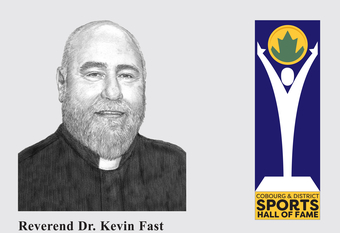
DR. REVEREND KEVIN FAST

DR. REVEREND KEVIN FAST

Reverend Dr. Kevin Fast was born in St. Catharines, Ontario, on April 13, 1963. Upon graduation, he served in several congregations before arriving at St.
Paul’s Lutheran Church in Cobourg, in 1992. Growing up he was of average athletic ability.

It was in 1994 that he discovered the Cobourg Highland Games. Although Kevin had never seen the events before, he accepted an invitation to compete and surprising himself – He Won! This motivated Kevin to attempt other feats of strength, some that did not seem to be humanly possible. He has pulled everything from fire trucks to trains to houses to planes.

As of February 2020, Kevin has recorded 34 world records for feats of strength and appears in the Guinness World Book of Records for setting 31 records. One of Kevin’s incredible feats of strength occurred on September 18, 2009 at the Trenton Air Force Base, where he pulled a 188,830.05 kg (416,299 pound) CC177 Globemaster III Aircraft a distance of 8.8 metres.

Along the way, he was dubbed “The Powerlifting Pastor” by his many fans and supporters. Kevin Fast has appeared on numerous TV shows that were covering his feats of strength. He has raised thousands of dollars for many charities. For example, by pulling a house and setting a new world record, he helped raise $70,000 for Habitat for Humanity. Kevin Fast is 5’9” tall and weighs 300 pounds.

His philosophy is simple – “God has given me the gift of strength and, in thanksgiving, I will use it for His Glory as long as I have it.” With faith, prayer and the love of his family – Kevin Fast continues to compete.