CDSHF

Cobourg

Sports-Cobourg Sesquicentennial 1987

Cobourg Sesquicentennial 1987

Cobourg Celebrates 1987 Sesquicentennial

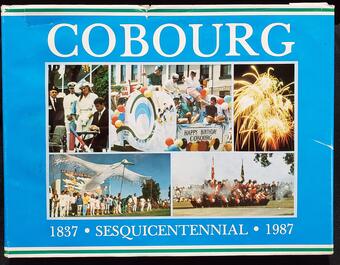
In 1987, Cobourg celebrated its 150th birthday (Sesquicentennial). A committee was formed in July of 1985 charged with the mandate of delivering a high quality and interesting 150th birthday celebration. Chairman of the Committee, Ralph Zarboni, describes in the book, Cobourg 1837- Sesquicentennial -1987…. “Thirty very talented people came together to create a program designed to remind Cobourg citizens of their heritage and history, and to make them aware of excellent future prospects. The celebration has, for the most part, achieved its goals. The nucleus committee of 30 expanded into some 250 representing all segments of the community, including many of our neighbouring municipalities.” 

Members of the Committee were: Ralph Zarboni, Chair, William Gadd Publicity, Bruce Margles Treasurer, Ruth Woods, Secretary, George Borthwick, Bill Daly, Norm Duncan, Lew Griffith, Marion Hagen, Helen Hawke, Ed Haynes, George Jeanneret, Bob Jenkins, Dr James Johnston, L. Col. Robert Lucas, Bob MacCoubrey, Don Macklin, Wayne Milroy, Dean Pepper, Eleanor Pifher, Ross Quigley, Most Rev. R. Seaborn, David Sheffield, Bonnie Sheridan, Ron Templer, Ross Tressider, Peter Tulumello, Roger Williams, Bob Wilson, Col. Ced Haynes, Linda Jacobson, Mark Finnan and Mike Korol. 

78 events comprised the Sesquicentennial program including: 
 * Cobourg Waterfront festival
 * Old Fort Henry Guard visit
 * Royal Canadian Horse Artillery Military Parade, show and exhibit
 * Art in the Park
 * Royal Visit: The Duke and Duchess of York
 * Cobourg Boy Scout Reunion
 * Hot Air Balloon Race (sponsored by General Foods).
 * Fiddler on the Roof, (a performance by Northumberland Players)
 * F18 Airshow
 * Sesqui Parade
 * Downtown window decorating and sidewalk painting 

As part of the celebrations a Sesquicentennial book was published (Ed Haynes Chair, John Spilsbury Editor, Cecil Davies Art Director, and committee members, Dr. James Johnston, Barbara Cameron, Col. Cedric Haynes, Col. Gordon King, Percy Climo, Roger Williams, Jean Haynes). A sesquicentennial resource book to preserve the history of Cobourg for future generations was placed in all public and separate schools in the Northumberland and Newcastle Board of Education (Helen Hawke Sesquicentennial Education Committee Chair, Barbara Garrick Chair, Ron Cameron, Yvonne Green and Wayne McCurdy committee members). 

The Cobourg Commemorative Dollar produced 25,000 mined silver dollar coins approved as legal tender within the town limits for the entire year as well as gold coins valued at $10, not legal tender (General Chair Georges Jeanneret, minted in Alberta, Royal Canadian Sea Cadets Skeena). The Sesqui Calendar, as a promotional fundraiser sold for $5 and produced by the Cobourg and District Historical Society provided 365 historical entries pertaining to Cobourg’s past. Pictures were provided by the Cobourg Colour Camera Club (Charles A Hagen was Calendar Compiler while Thomas W. Hawke was Project Chair, Lois Ann Verney, Photography, Peter Delanty and Bill Gadd committee members). 

The sports community played a part in the celebrations as well. Ross Quigley served as Chair of Cobourg’s Sesquicentennial’s Sporting Events Committee which included:  
 * January 6, 1987 - International Boat Show Sesqui Exhibit – Cobourg Chamber of Commerce, CYC
 * June 21, 1987 - 44 cyclists (19 from Cobourg) participated in a 150 kilometre bicycle tour. Cyclists came from as far away as Penetanguishene, Oshawa and Belleville. It was sponsored by the Cobourg Cycling Club Tour – Dave Singfield, Chair, Pamela and Henry Joachim, sponsored by Complax Corporation.
 * The sesquicentennial Fishing Derby under the chair of George Cortesis extended over a prolonged period commencing June 22 and ending July 5, 1987. John McIvor of Cobourg emerged triumphant, landing the 30.6 pound chinook salmon after a battle that lasted three quarters of an hour. He caught the fish near Shelter Valley Creek and won an electric trolling motor as the winner of the Derby. The official weigh-in took place at the Cobourg Marina. 

 * June 26-28,1987 – C.L. Dingy Regatta – Barbara Johns, John Turner, Nick Weyman, Chair, Committee: Ralph Curtis, Dan Goldring, Ed Billing, Jarl Northwood, Marilyn Macklin, Steve Swift, Ben Veenhoff, Alan Hallworth, Don Macklin, Peter Stirling, Donna Curtis. 
 * June 27, 1987 - Galloping Ghosts Football Reunion which consisted of over 230 participants coming to Cobourg to participate in the Sesqui Parade, dinner and dance. Former players came from as far away as Vancouver, the Caribbean, Montreal and the United States to join in the fun. Committee members were: Bus Edwards, Chair, Ken Cooper, Paul Currelly, Jack Newton, Ed Haynes, Bernie Flesch, Audrey Burdick, Ireland Quigley, Jim Redmond, Homer Seale, Chub Downey, Ken Medhurst. This was one of the most popular sesqui events. Many of Cobourg’s older citizens will remember Cobourg’s most famous sports team that won 3 Canadian or Dominion Championships, 8 Ontario Titles and operated in Cobourg from the 1930’s to the 1950’s and led by President/Manager Fred Dufton. 

 * July 3 -5. 1987 -Can-Am Keel Boat Regatta- Barbara Johns, Chair, John Turner, Jarl Northwood, Steve Swift, Alan Hallworh, Henry Meinster. 
 * July 4, 1987 – Highland Games held at Donegan Park and included 20 pipe bands and numerous heavy events and highland dancing. 21 athletes registered in the heavy events which included the caber toss (56 and 28 pound), stone throw and hammer throw in both the amateur and professional class. Another event was the road races. As part of the Timex-Toronto Star Road Race Series ’87, 182 men and women participated in the 3K and 8K races. Runners travelled from Sudbury, Ottawa, New Jersey and Sault Ste. Marie to compete against local participants. Jim McIlwham from Cobourg won the 8K race in the 50-59 age category. The committee members included Harry Gardner – President, Mary Gardner, Secretary, Ron Cameron. Race Director, Gord Hunter, Heavy Event Coordinator, Dr. Paul Caldwell. 

 * July 26, 1987 - Cobourg Sesqui Lawn Bowling Tournament – Bob Fulton, Chair. Headed up by Gord King and Wally Reid. The event took place at the Cobourg Lawn Bowling Club in Victoria Park. The club ran two major tournaments in 1987 – The sesqui tournament and a tournament to celebrate the 80th anniversary of the club’s beginning. 54 bowlers, some in colourful period dress were led in a parade around the Greens by Don Diminie with his bag pipes. A Spider then followed and was won by Art Jones. Teams of Trebles then played a 12 end game and stopped for refreshments of tea, punch and cake donated by Ladies’ President Alma McKendrick and Mens’ President Wally Reid and cut by Mayor Angus Read. A second 12 end game followed and at the finish most of the costumed participants agreed that long skirts, waist coats, collars and ties were not nearly as comfortable, especially in such hot weather, as our present day dress code. The ladies winner was Alma McKendrick, the gentlemen winner was Ron Wicks, the high score with 2 losses – 19 points went to Gordon King, Doris Stephens and Agnas Haas, the treble winners were Bob Fulton, Doug Coyle and Bruce Screaton. (info taken from a report written by Al Hoskin, Jetney Chair)

 * August 7, 1987- Sesqui Celebrity Pro-Am Golf Tournament – Dick Garrison, Jim Bovaird, Chair. This event took place at Dalewood Golf and Country Club. 600 volunteers and committee members coordinated 28 celebrities, 26 pros and more than 100 local amateur golfers to celebrate Cobourg’s Sesquicentennial and raise money for the Cobourg Youth Activity Fund and the Children’s Wish Foundation. The event raised approximately $30,000 in money and prizes. Many NHL hockey players, referees and linesmen attended along with other significant personalities. Spectators were encouraged to attend both the tournament on the 7th and the silent auction on the 6th (which generated $4,000 for Children’s Wish Foundation). Shuttle buses were available to transport guests to view Jacques Villeneuve’s Formula 1 car, a Carling 1928 Mercedes Antique Truck on Display at an antique car show and to meet the Toronto Sun Sunshine Girls.  
 * August 8, 1987 – Muskoka Water Ski Show – Don Macklin, Chair, Linda Jacobson, Dean McCaughey, Carl Vaida, Steve Mancusco

 * The 8th annual Quench Run sponsored by General Foods occurred on August 15, 1987. Racers ran distances of 4.7 and 10 kilometres in men, women and open categories. The 10K run attracted 200 runners and the 5K “fun run” had 90 that included five categories within each race. Cobourg’s Jim McIlwham captured the Senior’s category in the 10K run. Proceeds from the event went to the Multiple Sclerosis Society. Race Director Bill Hart.
 * August 15, 1987 - Sesqui  Regional Swim Meet – Bob Jenkins, Chair, Layton Dodge, Cobourg Family Y. The event took place at the Cobourg Family “Y” Centennial Pool and brought recognition to many of Cobourg’s fine young swimmers. The Cobourg Y Waves swim team consisted of 48 swimmers and 3 coaches, Glen Bryan, Janet Bran and Sean Andrus. This was the Waves’ first time to host a swim meet which consisted of 76 races for children 8 and under to 17 years of age. Teams who attended the meet were from Port Hope, Napanee, Ajax and Bowmanville. All participants received sesqui ribbons. Three Cobourg swimmers, Todd Simpson, Kyle Elder and Ann Marie McCormick received medals for high pointgetters in their respective age groups. Donations from the Sesqui Committee provided awards for the event. (excerpt taken from Deborah M. Elder Cobourg Y Waves Parents Committee.)

 * August 15, 16, 1987 – Sesqui Soccer- Cobourg Soccer Club’s 10th Annual Pepsi Tournament took place on the various pitches at Donegan Park, CDCI East field and the Industrial Park fields. 49 teams including 6 from New York state competed in 71 games over the two-day event in the squirt, atom, mosquito, peewee, bantam and junior divisions. Cobourg Junior Selects were undefeated in the tournament but due to a tie did not accumulate enough points to advance to the final in their division. Cobourg Spoolon Bantams were the most successful local team, losing in the finals to Newmarket. Kingston won the Peewee division, Peterborough the Mosquito and Oakville the Atom division. Roy and Pauline Cashin, Chair.


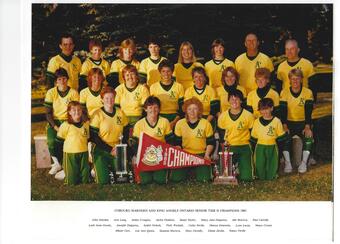
 * August 22-23, 1987 – Legion Sesqui Softball Tournament – O.A.S.A. Provincial Peewee “B” Division – This event occurred as part of the sesquicentennial celebrations and consisted of 8 zone winning teams from Napanee, Kemptville, Aurora, Unionville, Nanticoke, Port Perry, Smithville and host Cobourg. Napanee won their 2nd straight Ontario title versus Unionville. Norm MacDonald, Chair, Lionel Gutteridge, Linda Bevan, Sports Officer Bob Robison, Gary Smith, Dick Turpin, Steve Sleeper. **Background info** The legion has been sponsoring minor softball in Cobourg since 1958 when people like Lionel Gutteridge, Tom Savage, Jack Bevan, Cedric Smith, Layton Dodge and many others got together and formed a softball league for children of ages from 6 to 15, it has been going ever since. (taken from excerpt in Sesqui binder) 

 * August 22-23, 1987 – Countess of Dufferin 100 mile Yacht Race – Gord Atkinson, Chair, Mike O’Grady, Dan Goldring, Don Macklin. 
 * The Arabian and Western Horse Shows held at Donegan Park on Saturday and Sunday September 26 and 27th was sponsored by the Arabian Horse Association of Eastern Canada and the Northumberland County Riders. A wide variety and exotic costumes attracted a large turnout of spectators who witnessed a high degree of horsemanship competing in 32 events. Bob Jenkins Chair, Esther Johnson, J. Barton, Doug Routh, Pam VanZelzen.
 * November 7, 8, 1987 – The Cobourg Figure Skating Club presented their 5th annual skating competition and sesquicentennial ice show called “Skate Cobourg ’87” – David Cook Chair. The skating event featured skating stars such as Gary Beacom for local audiences to enjoy. 144 registered skaters including 60 local skaters participated in the 28 category sesquicentennial themed show/competition. Local skaters exceeded in the competition and included Jennifer Harper placing first in the Novice Ladies Competition, Melissa Knight, first Juvenile B Competitive Ladies, Sara Haukioja first in Beginner girls and Geoffery Mercer first in Beginner Boys. **Background History **….  (The first Cobourg Figure Skating Club began in 1949 with Mr. Ed Bovay as its President. The first of many Skating Carnivals was held two years later, in 1951. In the early 1950’s, summer skating schools were held in the Cobourg Memorial Arena. Two notable skaters attended at that time; they were Don Jackson and Toller Cranston. The Cobourg Figure Skating Club moved to Pad II after its completion in 1977. All club skating and test days are held in Pad II. (unknown author))***

 * Cobourg Community Hockey League: On November 21-22 the CCHL staged a successful bantam rep team hockey tournament with 24 teams participating. Niagara-on-the Lake captured the A series title with a win over Bowmanville. Cobourg Wholesalers reached the playoffs of the tournament winning 3 straight games but were eliminated by the Championship team, Niagara-on-the Lake. Gord Stevenson, Chair, Layton Dodge, Peter Campbell, Ken Petrie, Wayne Wiggins, Brian Keighley, Bill Elliott. **Background History**( The first meeting for the Cobourg Church Hockey League was called on December 3, 1934 and the idea of minor hockey was conceived by Rev. Father Wolf, a priest at St. Michaels Parish. The 1st President was Bob Jackson. The first year saw 125 boys sign up for minor hockey. There were four churches involved: St. Peters, St. Michaels, St. Andrews and Trinity United. Cobourg Minor Hockey was played on natural ice up until the season of 1949-50 when a new artificial ice Arena was built, now the kids of Cobourg and surrounding area could even play hockey in the Summer. On August 17, 1953, the Cobourg Arena burned down four years to the day it was built. Colonel Gordon King and his Arena Board along with volunteering citizens cleaned up the damaged building. Because the ice plant was undamaged, a new building was put up in the same site, with a better more comfortable and safer building. In 1960/61, season 388 boys signed up to play minor hockey; as the numbers continued to grow, the CCHL began sending teams to play in Colborne and Grafton. In 1974/75, the youngest President of the CCHL, Jack Greer came up with the idea for a 2nd ice Pad. A building fund committee headed by Jeff Rolph was formed and on April 1, 1977, Pad II Arena was officially opened, this was due to many people donating many hours to help Minor Hockey. The Cobourg Church Hockey League became the Cobourg Community Hockey League that same year (author unknown).) **

 * December 20, 1987 Olympic Torch Relay -sponsored by Town Council. 6,214 Canadians carried the torch from St. John’s Newfoundland across the country to Calgary for the 1988 Winter Olympic Games, a total of 18,000 km. 88 local citizens carried the torch for 1 km each and were selected at random from 2.5 million Ontario applicants. Three separate events occurred in Cobourg to celebrate their sesquicentennial and the arrival of the torch. Five Cobourg residents and the Royal Canadian Legion Branch 133 received Celebration ’88 medals at a ceremony outside of Victoria Hall for their contribution to sports prior to the torch arriving. Two athletes, a coach, a sports volunteer and an official were recognized. Runner Jim McIlwham and figure skater Jennifer Harper were honoured as Cobourg’s athletes of the year. McIlwham, holder of 8 Canadian running records for his age group was the outstanding male athlete and 13 year old Harper who earned a bronze medal at the 1986 Canada Winter Games, the outstanding female athlete.  
Others recognized were volunteer Marjorie Vandershaaf for her involvement in the Parents’ Athletic Association program at CDCI West high school and the Special Olympics; Paul Currelly for his contribution to amateur sports and in particular his involvement in girl’s softball for over 30 years; and Bruce (Red) Alexander who received his medal for officiating and his involvement in Church League sports including hockey, baseball and football for more than 30 years. A two hour production entitled “The Games of Winter” was staged at CDCI West and in the evening, the Concert Band of Cobourg presented a sesqui Christmas pops concert at Victoria Hall. These events celebrated the Olympic Torch arrival as well as rounding out the Sesquicentennial celebrations.  

The Sesquicentennial celebrations were a huge success in bringing the community of Cobourg and surrounding areas together. The sporting community played a large part in this celebration. As quoted from the book, Cobourg 1837-Sesquicentennial-1987, Chairman of the Sesqui Committee, Ralph Zarboni states the following:   
Mayor Read, Town Council, service clubs, business and others have been most supportive; giving unreservedly of their time and talents. This in itself, is a measure of the type of town Cobourg is!!! I take pleasure and pride in thanking all those contributing to the some 78 events that have comprised our Sesquicentennial program. I would like also to extend congratulations to the thousands of citizens and visitors who participated with enthusiasm.
We should all be most happy!!!

Ralph Zarboni

Sources:  Cobourg 1837-Sesquicentennial-1987;  The Cobourg Daily Star 1987 edition; Minutes, Sesquicentennial Committee


Add new comment

Restricted HTML

  • Allowed HTML tags: <a href hreflang> <em> <strong> <cite> <blockquote cite> <code> <ul type> <ol start type> <li> <dl> <dt> <dd> <h2 id> <h3 id> <h4 id> <h5 id> <h6 id>
  • Lines and paragraphs break automatically.
  • Web page addresses and email addresses turn into links automatically.
CAPTCHA
This question is for testing whether or not you are a human visitor and to prevent automated spam submissions.

Hockey-RBC Cup 2017-Nine Days in May

RBC Cup 2017 winners

NINE DAYS IN MAY

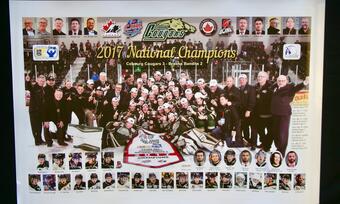
May 13 to 21, 2017 - The RBC Cup: The “Canadian National Junior A Championships” played throughout the week of May 13 to 21 at Cobourg Community Centre. 

The teams qualifying included the media darlings and favourites to win, “Brooks Bandits” from Alberta (West 1) featuring Cale Makar who was touted to go in the top ten in this year’s NHL draft. Also winning their way to the championships were the “Penticton Vees” of BC (West 2) who finished second to the Bandits; the OJHL’s Trenton Golden Hawks (Central) who defeated the Georgetown Raiders in the Dudley Hewitt Cup; the “Cobras de Terrebonne” from Quebec (East) and the host team Cobourg Cougars who were swept by Trenton back on April 6th.

The Cougars finished the preliminary round in first place by defeating Trenton 3-2 in OT; a 3-2 OT loss to Penticton and a 6-1win over Terrebonne; then defeated the Bandits 5-2 who choose to rest their top five players including their goaltender Mitch Benson and defenseman Cale Makar. In their semi-final game the Cougars defeated Penticton 3-1 to meet the Brooks Bandits in the championship final on May 21st with puck drop at 5:30 before a sold out house. The game, televised on TSN was everything it was expected to be with an exhilarating 3-2 overtime Cougar win when at 8:21 Nick Minerva one-timed it past goaltender Mitch Benson from the point on a pass from defenseman Matt Bumstead after Brenden Locke won the face-off in the offensive zone and Josh Maguire got the puck back to the blueline. 

Jamie Huber opened the scoring for Cobourg in the first and Brooks’ Connor Jean tied it up. The score remained tied until deep into the third when Bandits captain Nick Prkusik scored a big go-ahead goal with 8:31 left to play. Brooks was closing in on an RBC Cup victory in the third period when Cobourg's Ryan Casselman arguably scored the most important goal in Cobourg Cougar history when he buried a rebound from a Brennan Roy shot with 1:07 to play in regulation time to tie the game sending it into OT. The CCC exploded!

The rest was history for the Cougars, who went on to win their first championship as a Junior A franchise—a national one at that, which was their first since capturing the 1974 Ontario Junior C title. Goaltender Stefano Durante earns the top goalie award and is the final MVP. Spencer Roberts was the leading scorer and top forward for the tournament. Nick Minerva’s stick and gloves are enshrined at the Hockey Hall of Fame.
(Written with notes from Jeff Gard)

A number of graduates from this team moved on to further their education through hockey. Goaltender, Stefano Durante is playing for American International College's Yellow Jackets. Brennan Roy, Jesse Baird, Spencer Roberts and Cobourg native, Josh Maguire were recruited to UOIT by former Cobourg Cougars coach, Curtis Hodgins. Brenden Locke committed to Cornell University and Quinn Syrdiuk to McGill University. Sam Dunn of Hamilton Township played for the QMJHL's Ramparts before joining St. Mary's University Huskies in Halifax and Nick Minerva committed to Aurora College in Chicago. Assistant Coach, Corey Beer is now the Head Coach of the Timmins Rock of the Northern Ontario Junior Hockey League.


Sport Team or Name This Story is about

Add new comment

Restricted HTML

  • Allowed HTML tags: <a href hreflang> <em> <strong> <cite> <blockquote cite> <code> <ul type> <ol start type> <li> <dl> <dt> <dd> <h2 id> <h3 id> <h4 id> <h5 id> <h6 id>
  • Lines and paragraphs break automatically.
  • Web page addresses and email addresses turn into links automatically.
CAPTCHA
This question is for testing whether or not you are a human visitor and to prevent automated spam submissions.

Yacht Racing-1863 Lake Ontario Cruise

1863 Lake Ontario Cruise


AN 1863 CRUISE ON LAKE ONTARIO 

* Extract from a talk by Archibald Lamont delivered to the meeting of the Cobourg & District Historical Society October 1995
* Sources at end

Good evening, Ladies and Gentlemen.

You have a playground at your front door and this talk is about a great adventure on and around it long ago. Sailing about on Lake Ontario for pleasure and fun undoubtedly was a sport  soon after the  arrival here of people of European ancestry and possibly much earlier than that. There is one record dating from 1801, though C.H.J Snider tells us that "the first private yacht mentioned on Lake Ontario  "... was offered for sale in 1832." Since those  early days, there have been many thousands of cruises throughout the Lake, but very few stories exist describing their details. On August 3 of the year 1863, the Yacht BREEZE set out from the Royal Canadian Yacht Club on a cruise that resulted in a diary full of delightful detail. It is the purpose of this paper to pass on some of that delight to you. The diary today is in the National Archives of Canada, a gift to the Nation from George and Arthur Beddington, great nephews of the diarist.


BREEZE  ARRIVES AT COBOURG

I'm  going to start with an excerpt from the diary dealing with the arrival of the Yacht BREEZE at Cobourg on August 4 of 1863. Cobourg and some of its citizens figure prominently in the diary, many people being mentioned by name. Here is the arrival:

"At 8h a.m. we ran between Cobourg piers and met the RIVET'S dinghy taking her crew out to bathe. We were still at breakfast <but> two or three of us went on deck to get the anchor ready just as we entered the inner harbour, but were too late. Burrell, not knowing the way the boat carried with her,  luffed up too sharp, a puff of wind struck us just before, and so we ran straight into the wharf. Luckily, our bowsprit head was higher than the wharf so the bobstay lifted us. Loafers on the wharf shoved it off, and we anchored all right between RIVET and PALMETTO. The boats in harbour were the PALMETTO  and ZOUAVE of Hamilton, the BREEZE, RIVET and DART of Toronto, the ARROW, GORILLA, WIDEAWAKE, KITTEN and JOHN A. MACDONALD of Cobourg."

"After a pipe, I attired myself and went into town to call on the inhabitants. Did the Barrons, Chattertons and MacPhersons, the proverbial Cobourg hospitality flourishing like a green bay tree. The others loafed about town. All assembled at noon for tiffen except Morrison, Hancock, and Duggan. Mr.  Barron and Mr. Street visited us."

"Delicious as ever, in the afternoon many of the Cobourg girls assembled on board the RIVET. I joined the crew and we had a jolly sail; put down two buoys to mark the course. We had twenty four on board all told, not bad for a 16 ton boat. There was plenty of wind and little sea, so everyone enjoyed it immensely. We got in again at half past six, and I rowed myself on board the BREEZE just in time to join the rest at dinner. Just as we finished dinner, the Cobourg Band came down and getting on board the JOHN A. sailed about the harbour playing melodiously the while. All Cobourg turned out to stroll on the pier and enjoy the cool evening breeze. It was very free and easy and also very charming."

"(Just after midnight, we) returned from the hut of one Crusoe - no relation to Robinson - a "big bug" or sachem in these parts. To the sea rovers gave he a nautch, likewise beer. Many of the younger and fairer natives were present in their ordinary costume, reserving the full effort of their most gorgeous apparel for the ensuing night. Tattooing does not prevail along this coast. The religion is unknown and it matters not, but I have been credibly informed by some of the more ancient and unmarried females that their fair juniors are much given to the worship of a mysterious deity called theossifer."

In this short piece, we have learned some various things -what the Cobourg establishment did for entertainment, who some of that establishment  were, what boats were in the harbour, how the BREEZE came to town, what our diarist thought of the Cobourg girls, and so on. 'The Crusoe" mentioned was one of the local establishments, his "hut" was a big house, a "nautch" is an entertainment, and "theossifer" is "the officer". The diarist was engaged in arch humour in the whole of the paragraph.

BREEZE came to town because the people on board her were on a holiday cruise, and because Cobourg's fourth annual sailing regatta was taking place. They had four happy days ahead of them, but before I tell you of those days, I should tell you about the actors.


BAINES THE DIARIST AND HIS FELLOW OFFICERS

Our diarist was Henry E. Baines, 23 years of age, Lieutenant in the Royal Artillery, stationed at Fort York. Baines was at Fort York because of the reinforcement of that fort brought about by warlike threats against Canada issuing from the United States. I mentioned above that he belonged to an institution that regarded the Americans with some contempt, a view that derived from the fact that officers in the Royal Artillery considered themselves to be the elite of the elite, and thus superior to all other mortals. Besides, the Americans were the potential enemy. Baines was an experienced yachtsman, with his own small sailboat, and crewed in the Yacht DART for a summer cruise around the Lake in 1862. Like all Royal Artillery officers of the time, Baines had an intensive education in observations, in writing, and in illustration. All of these abilities were brought to bear in his preparation  of the  diary, as you will see. Baines incorporated into his diary many watercolour and other sketches and an unmistakeable joie de vivre and readiness to take life as it comes, as shown by his reaction to the events of the Regatta Ball. Three years after his wonderful cruise, he lost his life in line of duty at the big fire in Quebec City, dying a hero to the whole populace of that city.

Baines was on leave from his duties for one month while he enjoyed the cruise of the Yacht BREEZE on Lake Ontario. With him for the whole duration of the cruise were two other officers at the Royal Artillery, Lieutenants Woodfull and Harvey, and a law student, Fred  Duggan. All were under 25 years  of age. In addition to these, for the leg from Toronto to Cobourg, they had aboard four other military officers, who, with the owner and others, I will tell you about, made a total of twelve people!

Reading about that crew of young men on holiday so long ago is delight. Youthful spirits burst forth from the page, as they plunged into the cold water first thing in the morning to "bathe" or at other times, enjoy the company of young women. They made their way around the lake, signing, fishing, observing, bathing, enjoying the company of women at times, dealing with difficulties. Many have followed, but I doubt that any have enjoyed themselves more. The diary records that "none of us were possessed of any particular nautical skills, but we pulled well together, and took things as they came."  In other writings, I have referred to the crew of the BREEZE as "The Happy Warriors". And so they were.

Of them all, we have but one specific picture, sketched by Baines. One morning, "Harvey got into the dinghy with a towel and a big sponge and,  having disrobed, indulged in a regular sponge bath. He looked so pretty that we cast off the painter and set him adrift in order to have a good view from a distance. He looked like a mermaid, only rather more so."


THE YACHT BREEZE

For the cruise in 1863, Baines' boat was the Yacht BREEZE and his skipper Dr. Edward M. Hodder.

The Yacht BREEZE, was a wooden boat of 17 tons, cutter-rigged and deep-draught. She had no radio, no record player, no engine - no such things even existed. When the wind fell to nothing, she could only stay and wait where she was until more came along. Of the cabin arrangement, Baines says little, except that "To each man was assigned a resting place. The Commodore had the aftermost berth on the starboard side, I the one forward on the same side, Woodfull opposite the Commodore, and Duggan the one forward on the port. Mellor turned in with the Commodore, and Harvey spread a mattress between the berths on the floor. His were the most comfortable diggings of all, as, no matter which tack we were on there was no chance of his falling out of bed... As our uniform cases reposed in the cockpit, we were forced to adopt some dodge to enable us to have an accessible depot for tobacco, pipes, clothing and small deer generally below. Our plan was to raise the mattress and insinuate our stores beneath it so as to make a pillow. It was a crafty move, but from it came great grief to me hereafter."

BREEZE was built in Toronto in 1862 for Dr. Hodder, who had great hopes for her on the racing  circuit. However, despite that she was reported in the  newspapers as "very carefully built with the latest improvements faithfully carried out in model and rig... she had not fulfilled the expectations formed of her by her builder and owner. In time, as her points are better understood, she may exhibit an improvement." In fact, she didn't. Dr. Hodder   
abandoned BREEZE to another owner in 1868, and acquired a bigger vessel. BREEZE at some later time unknown to me, was "lost off the mouth of the Humber River," according to Snider.


COMMODORE  HODDER,  SKIPPER/OWNER OF BREEZE

Early  in  the diary,  describing  the  preparations  for departure,  the diarist  describes  "all hands acting as stevedores and the Commodore working and superintending like two." Other than this comment, and a sketch, he says nothing about his skipper. That is a pity, for there is a great deal to be said about the man. A sketch in the diary shows him during a stop at Presqu'ile, somewhat heavy, grey-bearded, his crew surrounding him, and his boat lying at anchor. Dr. Hodder was a big man not only physically, but also mentally and in the management of boats.

At the age of eleven years in 1822, Hodder went to sea as a Midshipman in the Royal Navy, serving with his father, Captain Hodder, R.N. His service in the RN. was cut short by a wish to study medicine. By the time of his death, his name "was a household word in Toronto. Skillful, cautious, affable, and handsome, he was a universal favourite." And no wonder, for the good Dr. Hodder was indefatigable. A practicing physician, he was also Coroner of Toronto, president of various medical bodies, a leading member of the active staff of two hospitals, a co-founder of a medical school, and dean for  some years of another.

With all his professional engagement, though, Dr. Hodder still found time to indulge his love of the maritime life, and indulged it whole-heartedly until  his death in 1878. Longer than any other, he was Commodore of the Royal Canadian Yacht Club for a total of over twenty years; from 1856 to 1878, there were few years in which he was not the lead man in that club.

He never forgot his early experience in the Royal Navy and was obviously a careful and competent captain of his vessel. When BREEZE approached  Weller's  Bay (Consecon Bay) in 1863, we can be sure there were no good charts showing this area in detail at the time. Even had there been charts,  they would no doubt have been unreliable, for that shore is a lee shore and there are shifting beds of sand on it. Never mind. The Commodore knew exactly what to do, "... having anchored and lowered head-sails, the Commodore and Burrell took the dinghy and lead line and proceeded to examine (the) opening. Soon returning, they reported it practicable." Those were exactly the procedures used by the great maritime explorers in the days not long before Hodder's experience as a midshipman in the R.N. Commodore Hodder knew his business very well indeed, and used his knowledge to help others.

At the time of the diary, the chart of the lake in general use was one produced in 1850 by Lt. Frederick L. Herbert, R.N., and published in Toronto. It gave soundings in the lake at large, but told nothing of the harbours and ports frequented by mariners. The Commodore, evidently unhappy with the lack of information available as guidance to the harbours, produced a little book in 1855, entitled THE HARBOURS AND PORTS OF LAKE ONTARIO. On the cover of his book, he describes  the contents as having arisen "from recent surveys and personal observations." His professional medical responsibilities show through his avocational interest when he writes in the preface to his book "it will gratify me, if through any effort of mine,  a single life is saved, or the smallest craft that navigates this noble lake is preserved from wreck."

With the book, he was not finished. At the time of its publication, he says that he has himself "visited every Port, with the exception of the Sackets Harbor and Port Ontario." By 1866, he had visited all, with no exceptions, and published a chart of the Lake that included the harbours for the 'first time. Baines doesn't say much about the activities of The Commodore on the 1863 cruise of BREEZE. It seems likely that he was off sounding the harbours in which they found  themselves, checking previous information he had developed and finding new things, all with the 1866 chart in mind.


"SHIP'S STAFF" OF THE YACHT BREEZE

To assist him in the running of his vessel, Hodder employed  a professional seaman, the pilot, "Burrell, a strong weather-beaten fellow." Says the diarist of him "This latter was a good type of the better class of Lake hands. During the summer season, he sails in one of the large schooners  that carry freights or corn grain or lumber from one lake port to another and occasionally ventures on a coasting voyage to Halifax or St. John. His wages might be $35 or $40 per month. In the winter when the navigation of the Lakes is rendered impossible by the cold, he betakes himself northward to the unsettled districts and traps the smaller wild animals for the sake of their skins. With tea and tobacco, he said, he could rough it anywhere, and I believe him. These Canadian sailors have a good deal of the American versatility in their composition. He was a most useful fellow on board, knowing nearly every harbour on the Lake thoroughly, and being a good seaman, though he was not accustomed to small craft. This made him distrust the ship and hesitate about carrying on a good deal at first, but latterly he gained confidence enough and made the most of her."

With two such men as Hodder and Burrell running BREEZE, it really is surprising to learn that, in the course of a three week cruise, they managed  to lose two dinghies to bad weather. But they did indeed.

For cabin duties, BREEZE sailed with a Private Miles aboard, but at Cobourg Miles was discharged for unstated reasons, and another "boy answering  to the name of Alfred was shipped and instructed  to make himself generally useful. A cadaverous loutish looking fellow, requiring constant stirring up, he saved us a deal of dirty work in the cleaning and cooking departments".

Finally, the ship's staff included Mellor, the Commodore's young son.


                                                I
THE STAY IN COBOURG

As we have heard, BREEZE arrived in Cobourg on August 4. Figuring prominently there in the shore-side activities of the next few days was the Globe Hotel, on the northeast corner of King and McGill streets. Built in 1848, it was touted as the "finest hotel between Toronto and Montreal, "a description  somewhat at odds with Baines' description of the ballroom. Its reputed grandeur did not save it, for it burned the year following Baines' visit.

From the diary, here is the whole of Chapter 3 describing part of the stay in Cobourg: 

"Awoke at six on the 5th, with many flies buzzing and biting. The morning bright and warm, no wind, bathed off the pier head. Oh, how warm that water was! Then clear up ship and breakfast at 8 a.m., pie, rolls,  ham, beef, tea, coffee, all well punished. Then a pipe. The second-class yachts, i.e.,  those under ten tons, started at 10 a.m.  - SLUG, just brought from Rice Lake on the cars, WIDEAWAKE, ZOUAVE, PALMETTO and KITTEN. We then took eight ladies on board, drifted out a little way, then a long rolling swell off the Lake and no wind - so hot! We got in as soon as we could and saw the first class yachts start at 1 p.m. The start was effected in this way. All the competing boats were moored on the lee of the windward pier with their mainsails up in order previously determined by lot. At a given signal their headsails were hoisted and they were towed out by the bystanders.

They got off well but the GORILLA being first had the advantage of a little puff of wind and gained a good start on the others, maintaining her lead until the end of the day. The others were the ARROW, JOHN A. MACDONALD, RIVET and DART. There was a light wind from the South. All day the race lasted, the wind at times falling altogether, then exerting itself enough to give a feeble puff for a few minutes, after which it became calm as before. It freshened, however, enough to bring the GORILLA in before the time allotted for the race had elapsed, but died away immediately, leaving the RIVET just outside.   Had the breeze lasted ten minutes longer, the RIVET would have saved her time and won the race. The WIDEAWAKE carried off the second class prize."

"The band played on board the JOHN A. as before and we loafed with many ladies on the wharf till they all took themselves off to dress for the  ball.  Mrs. Stewart, the Misses Hodders, and Miss Coewell arrived by steamer from Toronto and were forthwith conducted to the Globe. Harvey had taken a room there and I dressed in that. I had to go down to the bar to procure a ticket. It was crowded with loafers more or less drunk, smoking, chewing,  and spitting like Yankees." 
                                                                                               
"The ball room was dismal, insufficiently lighted, and papered with dark green and brown; it look like a cavern. The music was bad, the floor was bad and the supper was bad. The girls were good though and that covered nearly all the sins. I was bored into leaving at two. I stood at the door of the hotel talking for a few minutes when I noticed two gentlemen coming down stairs in each others arms and head foremost. About half way down the undermost hitched his leg in the bannisters and remained in suspense, while the other shooting ahead picked himself up and walked away. Imaging this to be a custom of the country, I remained quiescent and observant. Presently some bystanders disengaged the obfuscated and entangled gentleman  and took him into the bar, whence he speedily emerged followed by a fist. This time he fell soft on a group of loafers who scattered in confusion. Much noise and talking but nothing practical ensued so I went home to bed. This was not the only row that night."


"6th August. Could not manage to get up as early as usual this morning. I had, however, my accustomed tumble in off the pier head, and performed my toilette satisfactorily. I was fortunate enough to possess a small bag in two compartments originally intended for shaving tackle but now made to carry brushes  and soap. This I slung to a towel and always took with me when I went to bathe. I scrubbed my hands and cleaned my teeth while swimming in the lake and brushing my hair was an agreeable pastime on the road back. When bathing off the yacht we used a tin basin turn and turn about for any soapy ablutions. One small mirror was provided by the commodore and it always  turned up providentially on our nearing any port with a town attached to it. Elsewhere it remained perdu as nobody ever looked for it. After bathing this morning, I went to a barbers, got myself shaved, and then joined our party at breakfast at the Globe. Then a pipe and a prowl into town.

About midday the ladies gathered to the ship and we ran out some seven miles to the southward to watch the race. It was a good sailing day with plenty of wind and unfortunately a proportionate amount of sea running.   Several of the ladies yielded to the weakness of their dear little interiors but we never mention names. Mr. Lanon, Harvey, Woodfull and Dugmore,  gathered around the weather shrouds and did vocal melody "an it were any nightingale". The unfortunate RIVET was becalmed between two other boats some few hundred yards on each side of her, both of whom had plenty of wind, so when at last a cat's paw came her way, she put about the returned to port. We soon did the same and disembarked our precious freight."

"Then the Toronto party all dined together at the Globe and spent a very pleasant evening at Judge Boswell's. Music and dancing, strolling on the lawn, and sitting on the steps, very sociable and jolly. About one a.m., we all strolled down to the pier to see Mrs. Parsons off to Toronto. The boat from Kingston came in at two looking very pretty with her long row of cabin lights and coloured lamps on each paddle box. Farewells over, I turned in aboard the BREEZE."


"7th August.   Matutinal swim, breakfast at the Globe. The Breezers and ladies from Toronto assembled at Judge Boswell's at eleven. Traps and quadrupeds were collected and we started for Rice Lake. Arthur Boswell, Bogert and I took the last thing on wheels and disappeared. It was a kind of gig drawn by the spectre of a horse who appeared ready to go on his knees every day and beg that twenty four hours more life might be vouchsafed to him. We came up to some others of the party at a public house (or tavern) about halfway, called Cold Springs. To them we accounted for having brought our beast so far by saying that he luckily fell to pieces near where another of the same class was grazing, so we mended him up with odd bits from this other. The road was pretty and changing its character constantly, now winding along the foot of a hill, now through deep woods, then emerging into open cultivated country with farmhouses  scattered  about. There was interest enough to carry us through the twelve miles without our feeling bored.

It was a blessed hot day, threatening rain now and then but the sun always prevented the clouds carrying out their intention. When we arrived at Gore's Landing we found all assembled in the hotel planning boating expeditions. The greater part of us got on board a small yacht and stood out into the lake. There was a light breeze just rippling the deep blue water. Some thirty miles in length, the lake only averages a breadth of three. It is fed by three good sized streams, the largest of which, the Otonabee, falls into it nearly opposite Gore's Landing. The Trent, its great effluent, runs out of the East end into the Bay of Quinte at Trentport.

But the chief beauty of the lake is its islands. I do not know how many there are but they are all very lovely, covered with trees to the water's edge, they show every variety of tint and colour in their foliage, and stand out well from the more distant wooded capes or tawny meadows on the Northern shore. The peculiarity of this lake to English eyes is the wild rice which grows in the deep water and lifts up its pale green feathery head in thick profusion through beds a mile and more in length. Round the islets and across the rice beds we cruised till the wind fell and left us fairly becalmed in a rice bed on our way home. A friendly tow brought us to our mooring and we prepared for dinner noways loth. Three of the party had been fishing and had caught some fine black bass, two of which weighed about 4 lb. each. The first dish at the dinner table was Maskinonge,  the king fish of these lakes. It is more like a gigantic pike than any other English fish. This dish received due attention but did not at all interfere with the rights of those which followed it. The beer was good and plentiful and all things went happily. Then pipes and I made a rough sketch of the lake from the hill by the hotel."

"By this time shawls were being brought out and the horses were put to. Fred Duggan was offered to us in exchange for Bogert who was wanted to make up a quartette in another carriage. We examined the amount of sitting down room required by each of us (three in a gig, you see) and consented.  Our dilapidated ground plan of a horse soon fell in rear of the others though we started him with a spurt and by the time we got to Cold Springs it was dark and raining."

"Damper and darker it grew till we could no longer say whether we were on the road or not but had to give the perfidious old beast his way. He, being probably incited thereto by the fresh smell of a hedge or rather creepers over a snake fence, for hedges are not in this country, meandered along till suddenly one wheel went down, the other up, and we found ourselves in a heap on the ground. Having taken a wrong turn on entering Cobourg, it was eleven o'clock before we reached Judge Boswell's. What a lot of tea we continued to drink when we had been wrung out and hung up to dry. At last we were forced to cry hold and I returned to the yacht. On my way down, I looked into the Macpherson's where dancing and generally jollity were going on. Wet, dirty, and tired, I presented myself in the ballroom and the very fact of the large patch of mud on my quarter which I thought the worst part of the business proved my excuse, for an upset story accompanied by such stern evidence covered all my sins, lateness and disreputable dishclout  appearance into the bargain."

"It is perfectly marvellous how things that under ordinary circumstances you would never dream of getting into accommodate themselves to all one's personal peculiarities when on a cruise."

"Judge Boswell's coat fitted me a merveille at tea and I was equally at home in one of Jim Macpherson's at the party. After a while, I found myself too limp and tired to be up to the mark so obtained permission to depart. The yacht was some three or four yards from the wharf so I went to the hotel and had a pipe. Then the ladies had to be put on board the steamer for Toronto. It was blowing and there was a pretty heavy sea running out in the lake. Consequently, it was three in the morning when the steamer touched the wharf. No berths could be had but Clarkson and Cobden went off with the ladies and we trusted to them to manage. Just had time to run ashore before the gangway was hauled aboard. Then back to the hotel, loitering a moment to watch the great lights of the steamer in the long slow heave over each wave till they grew less and less and then went behind the thick black veil of darkness and rain."


"8th August.   As several of the visitors attracted to Cobourg by the double event of regatta and ball had departed, I easily obtained a bed at the hotel.  Not being likely to enjoy one again for some time, I made the most of it, and breakfasted pretty late. It was dead calm. I went down to the harbour and had a pipe. Then Fred Duggan turned up and we watched the drooping flags and motionless clouds. Consulted Burrel but got no hope from anything. There was a wee wee steamer, about as big as an ordinary row-boat close to us. She had crossed the lake from Rochester, where we met again. A small house in which were two apartments was built in her by way of cabin. Aft was the engine and forward two bunks. In the bow a regular flagstaff with the Stars and Stripes floating from it. If four fellows had taken her flag, one at each corner,  they could have wrapped the boat in it and carried her off bodily."

"At last we got tired of watching her manoeuvre and concluded to search for the commodore; ran him to earth at Judge Boswell's. We agreed not to go out because there was no wind to take us out, and went through the town in search of tin-ware, fishing tackle, etc., etc. Having bought all we could buy, we marched through the streets carrying kettles and pans in regular procession to the ship. We dined on board at six. By the time our pipes were out, Bogert came down attended by ladies. Then the steamer from Toronto arrived; Bogert was put on board and somehow or other we all found ourselves in sailor costume spending the evening in the Judge's drawing room. That night everyone slept on board".

"9th August. At half past six, we shook ourselves out of our blankets and proceeded to tub. Woodfull and I took the dinghy to the west pier and had a bracing swim in the clear cold water. While we were dressing and doing toilette, a man having the appearance of a half drunk cobbler arrived accompanied by two small boys. He was very loquacious and inveighed against the uncleanly habits of the Cobourg populace who preferred a basin in their own rooms now and then to a daily swim in the big lake. His own lavatory tendencies he explained by saying he had been a soldier and then gave us many curious and interesting details of the bathing parades at Gibraltar. Furthermore, he informed us that every English soldier was obliged to learn to swim, and that now regular skating parades for the troops were held in Canada during the winter. We were hungry, and preferred breakfast to acquiring more knowledge so wished him good morning and returned to the ship. After breakfast, we warped out of the harbour under sail. The wind was light but steady from the Southwest. Goodbye to Cobourg."


The Cobourg Sentinel of 1863 reported "Mr. Wallace was the first of our citizens who risked capital in yachting, and to him we are especially indebted for the many pleasant days we enjoyed during the past few years. We congratulate our townspeople on this late addition to our reputation and should they succeed in bringing back that "Prince of Wales Cup" to Cobourg, we assure them their claims to make Cobourg the capital of the Yacht Club cannot  be resisted, and their right to have the flag-ship, now in Toronto, removed to Cobourg harbour is indisputable."

Like all towns, Cobourg had its establishment. It appears from the names cited by Baines in the diary that Commodore Hodder was well acquainted  with it, and we can readily imagine the good natured, though sharp, awareness he had that his hosts were envious of the position of the R.C.Y.C.. Henry and his fellow  crewmen, little involved in the jockeying of their betters, would have been delighted with the establishment families they went to see, for most of them had daughters to meet and party with. Thus, "Judge Boswell" (George M. Boswell) mentioned several times, was a County Judge, 54 years of age, with home at Lowwood. Others of the roster from the diary or the newspaper accounts were:

•  A.G. Boswell (the "Arthur" of the diary), Barrister,  29 years of age.
•  H.G. Boswell, Division Court Clerk, 24, with two servants.
•  W.J.  Stanton, Solicitor, 23, with three servants. Agent for a large life insurance company.
•  F.W. Barron, Headmaster, 48. Daughters Emily and Agnes. Barron was a "jolly, plump, little man, quick-tempered, but warm-hearted and kind". He had a yacht of 14 tons (on Rice Lake?) Archibald Lampman ('the Canadian  Keats') was one of his students.
•  G.S. Daintry, Gentleman, 48. Daughters Emily and Jane. A singer on occasion, for he is reported at one gathering to have sung 'The Fine Old English Gentleman', and the newspaper account went on to characterize him, saying of him that "he himself is  a most  perfect  specimen."  Daintry was Lessee  (proprietor) of the Cobourg and Peterborough Railway.                                                                                          •
•  R.D. Chatterton, Deputy Clerk of the Crown, 56. Living at Havelock.
•  D.E. Boulton, Barrister, 44, a Colonel in the militia, with three servants. Daughters Emily and Mary. Boulton was Chairman of the Board of the school  of which Barron was head.

The older of these members of the establishment were 'from England, as were Commodore Hodder and his Royal Artillery crewmen. That they were the establishment is clear from the newspapers of the day; Guillet's scrapbook of clippings recites many of their doings. That they were very English too is also clear - at one dinner it is reported they were served "The  Roast Beef of Olde England".

Poor Cobourg! Try as it might, it couldn't overcome geography. Toronto had the protected harbour and the population and the money centres and the politics - everything in short, and the Royal Canadian Yacht Club, that "flag-ship", stayed there safe and secure against Cobourg's machinations.


THE  HAZARDS OF THE LAKE

"Lake  Ontario is a noble sheet of water on a calm summer day, blue with the deep ultramarine of the Mediterranean, changing in a fresh breeze to bright sunny green, with drifting purple cloud shadows, and as the gale grows fierce rising into the power of black blue waves crested with flashing white foam. It is hardly in any one aspect distinguishable from the outer sea." Those  words, with which Baines started his diary, will bring an emotional response from all who have sailed the lake. They also establish Baines as an observant man with pronounced artistic leanings.

The month of August 1863 was a difficult one for boats on Lake Ontario, whether large or small, and BREEZE had its share of those difficulties. Here is  what was  recorded in BREEZE on August 11: "At about five o'clock pm, we were nearly off Long Point, the wind was steady and there was nothing to do. All at once, the sky clouded over to the South West. We watched it earnestly and it soon became evident that a pretty heavy squall was coming up.   We took in the jib and double reefed the mainsail. One squall passed astern of us towards the North East. After a very short consultation, the mainsail was lowered and hurriedly stopped. Then the wind fell nearly calm. All the sky was dark with a strange blue tint over it. First drifted above us a long line of pale gray clouds with broken streaming edges. Then out of the South West burst three flashes of lightning flooding the whole sky with intense brilliancy.

While our eyes were still dazzled with the flare of the last, the squall burst over us. <There was> a sudden violent gust of wind then <a> steady hard blow with thick streaming rain. We knew well enough that coats were useless so met it in shirts and trousers only, barefooted too. It deluged us at once. The wind was so violent that we could not keep our faces to it. The dark lake changed to a pale gray with the crests of the
waves marked in broad lines of dull blue. Everything on board was snug and fast, Burrell at the helm. We drove through the water under our foresail sheeted down close at a grand pace. We made a stout rope fast to the dinghy and paid out some five or six fathoms that she might be clear of our counter. Harder and harder it blew and still we drove before it. A large schooner away to the southward caught it hot and heavy. She let go everything but the fore staysail with a run and kept the same course as ourselves:

"Presently the sea got up, following us at first in short broken waves, which by degrees grew into long regular masses of dull green water like billows at sea. The dinghy was terribly tossed about. At last a wave slewed her on one side, the painter slackened, then tautened suddenly. The staple was torn out and our poor little boat was left alone on the wild sea to shift for herself. The first fury of the squall was now spent but it still blew a gale and the sea grew heavier. From North, South, and East, the lightning flashed incessantly,<and> overhead the thunder crashed at short intervals. All the sky was black except one very beautiful break to the west ward: a clear space amongst the clouds orange golden over the blue trees of Prince Edward,  reddening upwards to the bright edges of the storm a narrow space of pure white rack beneath which the broad shield of the sun floated in light. Over against this stretched the full arc of a perfect double rainbow... 

"The squall was heavy on the lake. The steamer from Toronto unable to make Cobourg ran on to Kingston. The BANSHEE from Kingston put back with her bulwarks carried away. Off Port Hope, the RIVET lost her mast and with difficulty got into Cobourg half full of water."

August in 1863 was a bad time for storms on the lake. The one just described occurred on August 11. On the 20th, the 22nd, and 24th, they again experienced very bad weather; their second dinghy, acquired in Kingston, was lost on the 20th. The storm of the 22nd resulted in the loss of the schooner FLEETWING off Cobourg. She overturned when struck by a squall, drowning the Captain's wife, child, and steward.

On the 24th, they took off early, after an austere breakfast;  Baines' account of the morning is short: "We all rose at five. It was blowing pretty fresh so we decided on breakfasting at our moorings. Eggs and a biscuit and a half a piece were ready at seven. At eight o'clock, we were underway carrying the storm jib and two reefs down in the mailsail. When outside, we found the wind was south south west and not so fresh as we had expected. Then we set the topsail. It blew harder as we got on and we took two reefs in the mainsail and set the storm jib again. By this time, we had got past Pultneyville, a small village which struck me as being rather a good type of those generally seen along the lake and I made a sketch of it accordingly."

"To the northward of us was a propeller who did not appear to be making good weather of it. When on our gaining tack we rather 'whipped' her but we lost  again when we stretched inshore, which was occasionally necessary as the wind was against us. BREEZE encountered other boats and ships rather frequently  on the lake. Says the diarist "Many a huge steamer built in tiers like the Tower in Babel in old pictures, churns up the blue water, leaving a broad pale foam track as it rushes from port to port. Many a tall white schooner bears to Eastern marts the wheat of Michigan or corn from the waving plains of far Wisconsin. In rough unwieldy raffs the massive logs of pine and cedar from the depths of many a dark Canadian forest journey slowly to be broken  up under the classic heights of Quebec; and amongst all these flits from time to time some trim clean-sailed yacht, like a bright careless butterfly hovering in the midst of the busy respectable denizens of a farm yard'.

On a stroll at Oswego  he reports:  "Woodfull, Harvey and I pursued our peregrinations to the end of the wharf whence we counted twelve schooners  leaving the harbour at nearly the same hour." Many such schooners, returning to Oswego in storming conditions, failed to make the entrance  and ended on the rocks.


VISITING AMERICAN PORTS IN TIME OF WAR

After stops in Kingston and Prince Edward County, BREEZE visited various American ports - Sackets Harbor, Oswego, Sodus, and Charlotte (Rochester). To see into the depths of the diary's records of those ports, remember the diarist's background. The important facts are that he was an officer in the Royal Artillery, and was stationed at Fort York in Toronto. Canadian newspapers of the day were full of news of the war going on in the land to the south. The Globe reported on it regularly in detail on the front page, under the banner "The American Revolution", The Leader under "The American War." Dispatches, reports, letters, editorials, were endless in their examinations. We can imagine that talk and chatter in the messes of Fort York in Toronto, the examination of professional matters, the rumours - and the possibility of involvement.

Baines was in Toronto because of the threat from the south. In 1861, the British mail steamship TRENT had been stopped on the Atlantic by an American warship, and two Confederate diplomats taken from her. One of many consequences of the big hoorah that followed was the strengthening and extension of the defences of Fort York, including the addition of seven heavy artillery pieces. To serve those guns properly, several brigades of the  Royal Artillery were posted from England and newly stationed at Fort York, and Baines arrived. As mentioned earlier, the Royal Artillery was an elite regiment, and considered by its officers as the elite of the elite. All the rest of the world were much lower in the scale of worth and value, especially the Yankees.

The contemporary concern about the American threat was soundly based, it seemed, for loud and marshal! sounds, with much breast-beating, did emanate from various American quarters, repeatedly. Said the Globe editorially on August 1 "... many good people are greatly exercised by the threats of the New York Herald that when the war is over, the Republic will proceed to polish off England and France."

What is a good and loyal officer of the Royal Artillery to think, what to do, in a climate of such a kind, one that promises that his professional abilities may soon be called on? Even on leave, Henry responded, though gently. Passing the exposed railway line on the shores of the lake just out of Toronto,  he sees and writes that "enterprising Yankees" could do it in with little trouble. "A moonlight night, a spade, and a bag of gunpowder are all they want,"  says he.

Henry wasn't finished; cruising amongst the despised Yankees provided opportunity for another role, as spy. Much of what he reports at Sackets Harbor can be seen in this light, in addition to that of the ordinary tourist's curiosity.


Apart from his spying, here is some of what he had to say about Sackets: "We found ourselves anchored nearly in the centre of a wretched little harbour lined with rotten quays and rotting vessels. One large schooner on the stocks and another smaller one newly launched were the only signs of real shipping about the place. On our left as we entered the harbour was a big barrack on high ground. Remains of a breastwork along the edge of the low cliffs here and there gave it the semblance of being fortified, but we saw no guns. In front was the town, and on the right the wharf with the ship house and behind it a small promontory with a few good houses on it. As soon as we had made ourselves decent we proceeded  ashore. The Custom House was opposite us and we landed just below it. To our left was what appeared to be a guard house from the number of soldiers lounging about. A long-haired round-shouldered dirty set of fellows they seemed. The Customs office was shut up, but a contiguous loafer 'guessed the officer was to the hotel'. This  being close by we proceeded thither and found a big square house with solider-pervaded verandah, but no excise officer.

Up and down the single street of Sackets Harbor we searched for a butcher, all in vain! One store labelled 'Meat Shop' we came upon but it was closed. A fearfully dreary place it seemed to be, two thirds of the shops shut and no one in the remaining ones. All over the town, clustering in knots at the hotel, loafing, chewing, and liquoring, we found soldiers. They belonged to a corps being raised in the country whose headquarters are at the barracks on the hill.   Their costume consisted of black felt hat looped up on one side with black feathers on the other, and gilt cross muskets in front, blue jacket with yellow braid and blue trousers with yellow stripes. Pink stripes we saw too but I am inclined to think they were not regimental. Their boots were of many patterns and some wore spurs. They were called the McClellan Cavalry, but were not horsed as yet. Saving these we hardly saw a man in the street and but very few women. Nothing approaching to a lady. The attractions of the town were soon exhausted. The hotel, large, dirty and bad, produced no beer."

At the end of the War of 1812, fifty years earlier, the Americans had had a big ship a'building at Sackets; she was the U.S. NEW ORLEANS, a very big ship indeed, as she was intended to carry 120 guns. At war's end, she was not yet finished, and the Rush Bagot Treaty proscribed such vessels on the Lakes. Despite the treaty and following their old precept - "Trust in God and keep your powder dry'' - the Americans kept their big ship against an evil day. Who knew when she would be needed again! A big house or shed was built over her against that future need. The Happy Warriors from the yacht BREEZE visited the big ship in its big house, climbing the ladders alongside the ship. In doing so, they got out their pen-knives surreptitiously and tested the timbers. Says the diarist "I carefully stuck my knife into occasional timbers and satisfied myself that she was not good for much. She is in fact rotting from old age."

While at Sackets, too, they made a tour of the Fort, talking at length with some of the officers. Baines' military observations were primarily that there were sufficient guns facing the sea to "secure the harbour against any attack by sea", but that other guns were "totally unserviceable." At Oswego too, he had comments about the Fort, albeit brief, and not as thorough as a really good spy would have made them. I can imagine him, rather satisfied with  his findings, reporting them to his superiors on return to Fort York, though I expect they were well known to the responsible authorities anyway!


AN UNHAPPY DAY AND END OF THE CRUISE

Going  on, they came to Charlotte, the port of Rochester, and lay there for a day. The diarist's account of how he stowed his clothes under his mattress was brought to a point on the arrival in Charlotte. Says he "At three o'clock we had moored alongside a low wharf just below the railroad station and steamboat moorings. Having made the ship snug, I proceeded to get out my best and only decent suit of clothes, which had been stowed away under my mattress as before described. I was much pleased at discovering that a bottle of varnish kept in the adjoining locker had broken from its moorings during our recent tossing and streaming through the intervening bulkhead had thoroughly saturated my coat and, not to put too fine a point upon it,  pants. Of course, my hands were covered too as well as whatever else was in the neighbourhood of the locker. The varnish was an oily black liquid used for the stays and ironwork of the ship."

Despite the disaster, they had a great time sight-seeing in Rochester. Then it was off across the lake to home and the diary's last words "The cruise was over."


THE DIARIST'S LAST DAYS

By 1865, the military threat posed by the United States had receded, and there was no further need at Fort York for Baines and many of his fellow artillery officers and men. He left to join the garrison at Quebec City, taking passage as far as Montreal in the passenger vessel MAGNET. Baines wrote a poem, a nostalgic bit of doggerel, about this end to his sojourn at Toronto. It was in some degrees prophetic, as he wrote the words "No more for me the breeze may blow." He was soon to die. Leaving Toronto on board the MAGNET, 23 May 1865, he wrote,

"Far back the low smoke trailing lies, 
Back streams the broad white foam, 
And backwards still I strain my eyes 
Toward our three years home.

A black streak on the clear calm sky,
White on the deep blue lake -
'Twixt lake and sky thoughts backward fly,
From foam below, from cloud on high
Their two-fold hue they take.                                                                                                          I

Through dark regret for all I leave,
For hands I clasp no more,
There gleam fresh hopes my fancies weave
For all that lies below.

No more for me the breeze may blow, 
From sky so clear, o'er lake so blue, 
Perchance I n'er again shall know
A life so calm with friends so true.

As in those years that ran their sand,                                                                                        
In bright grains dropping day by day
Where fair Toronto lines the strand
With masts and spires far away.

So far away,  and now more far, 
Still farther growing - fading still,
The lake verge rises like a bar
'Twixt me and them - they fade until                                                                                         

They die in distance and the sky,
Rests all unbroken on the lake -
Three years die with them - so, Goodbye
New life begins as old links break.

But still where'er my fate may lead, 
By Indian palms or dear home shore, 
No quiet dreams at even fall,
Old forms will rise - old voices call;
Thee past will claim my heart and ah!
The dear old time be mine once more."

"He was soon to die," I reported above. He did so on October 27, 1866, in the General Hospital Convent of Quebec City. On Sunday morning  of October 14, when a serious fire was threatening Quebec City, military and naval units were called out, Baines amongst them. He led a demolition crew,  attempting to establish firebreaks. In one building, premature ignition of the charge resulting in serious injuries to Baines and his sergeant. Lovingly nursed by sisters of the General Hospital Convent, he developed tetanus and died in their care. His death led to an explosion of grief, public and private. There was a great public funeral with a major procession of all local dignitaries and authorities, and a large monument was erected in his honour in the cemetery. To this day, his picture delivered by his best friend, Lieutenant Harvey, hangs in the Hospital Convent and Sister Cloutier has written me, saying "Je puis vous dire que son souvenir s'est perpetue en notre communaute jusqu'a ce jour''."

We know a little of the future of Baines' fellow officers in BREEZE, those Happy Warriors. Woodfull went on to another fifteen years as a surgeon in the Artillery. Baines best friend, Lieutenant Harvey, rose over the following 26 years to be Lieutenant Colonel, having served in various parts of the Victorian British Empire. I'm sure he never forgot his friend, Baines, nor the cruise of the Yacht BREEZE with its high jinks and happy days at Cobourg.


SOURCES

•   "A Month's  Leave; or The Cruise of the Breeze", a diary authored by H. E. Baines, in the National Archives in Ottawa.
•   Contemporary newspapers of Toronto and Cobourg, in the Metropolitan Toronto Reference Library.
•   Papers in the General Hospital Convent in Quebec City.
•   Papers in the possession of Arthur Beddington of Toronto.
•   Archives of the Royal Canadian Yacht Club.
•   Archives of the Cobourg and District Historical Society. 

*  Image at top - Early map showing relationship of Cobourg to York/Toronto and Kingston courtesy Cobourg Museum Foundation


A NOTE OR TWO

The Baines Diary has over twenty watercolour and half a dozen black-ink sketches. Slides showing some of these were presented at the talk.

In editing the Baines Diary for present-day audiences and readers, a problem arises similar to that facing publishers of some of Shakespeare's work.    Should language offensive to the present times be retained or not? In the Diary, Baines speaks in a belittling way of women, of black people, and perhaps of others. In this transcript of 1995 talk about BREEZE, I have chosen to retain Baines words as he wrote them. The implied views that result from this are Baines', not mine.



Sport Team or Name This Story is about

Add new comment

Restricted HTML

  • Allowed HTML tags: <a href hreflang> <em> <strong> <cite> <blockquote cite> <code> <ul type> <ol start type> <li> <dl> <dt> <dd> <h2 id> <h3 id> <h4 id> <h5 id> <h6 id>
  • Lines and paragraphs break automatically.
  • Web page addresses and email addresses turn into links automatically.
CAPTCHA
This question is for testing whether or not you are a human visitor and to prevent automated spam submissions.

Hockey-Cobourg Cougars Jr B 1965-1971

Cobourg Cougars Sweater 1965

Cobourg Cougars Junior B 1965-1971


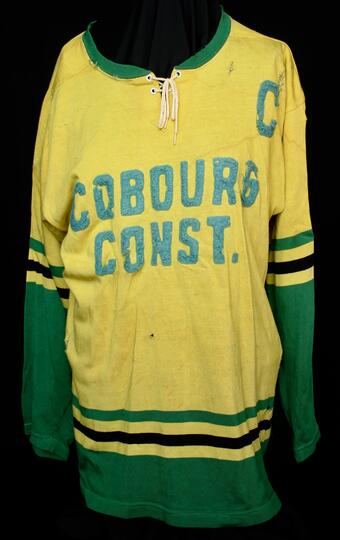
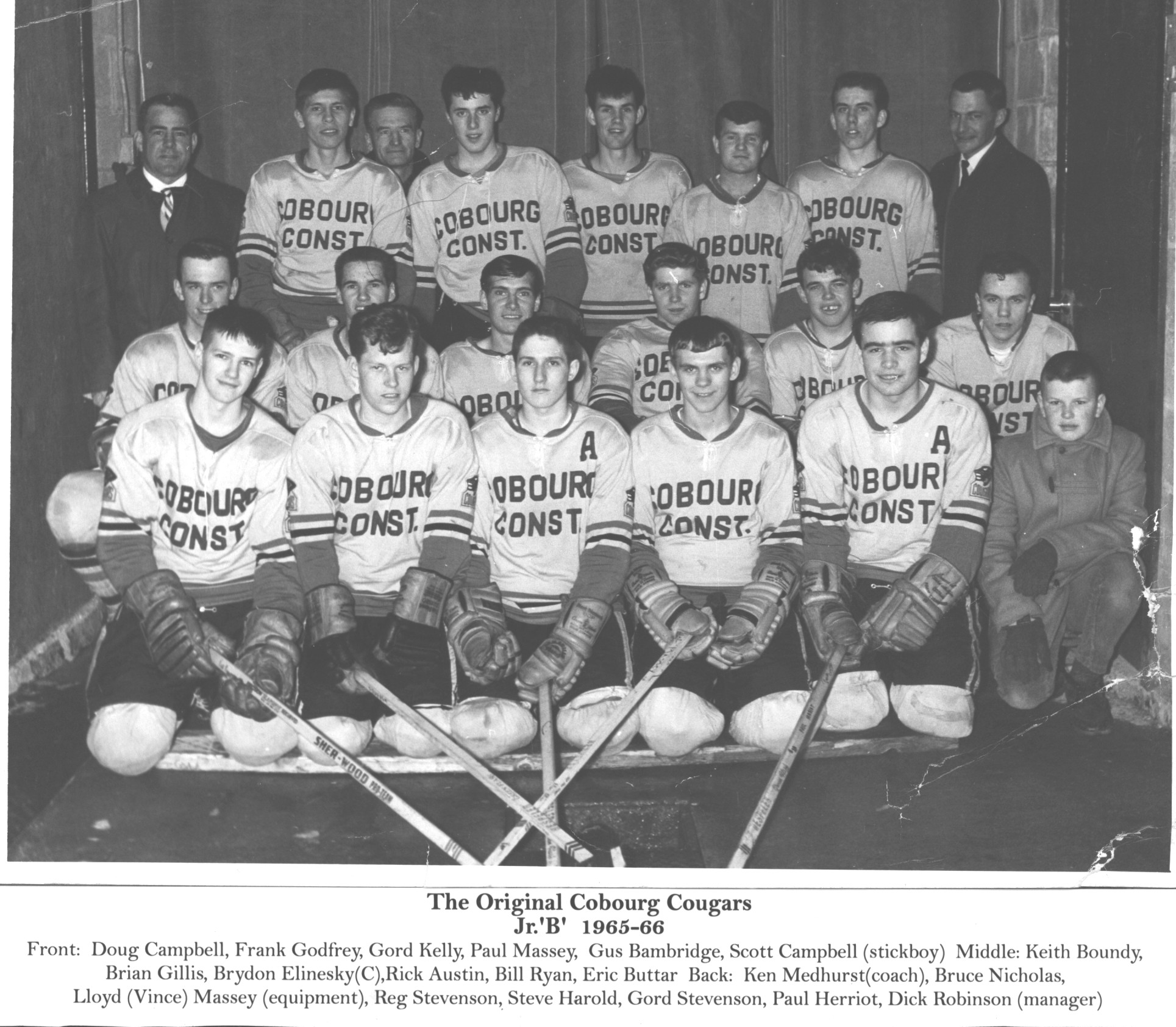
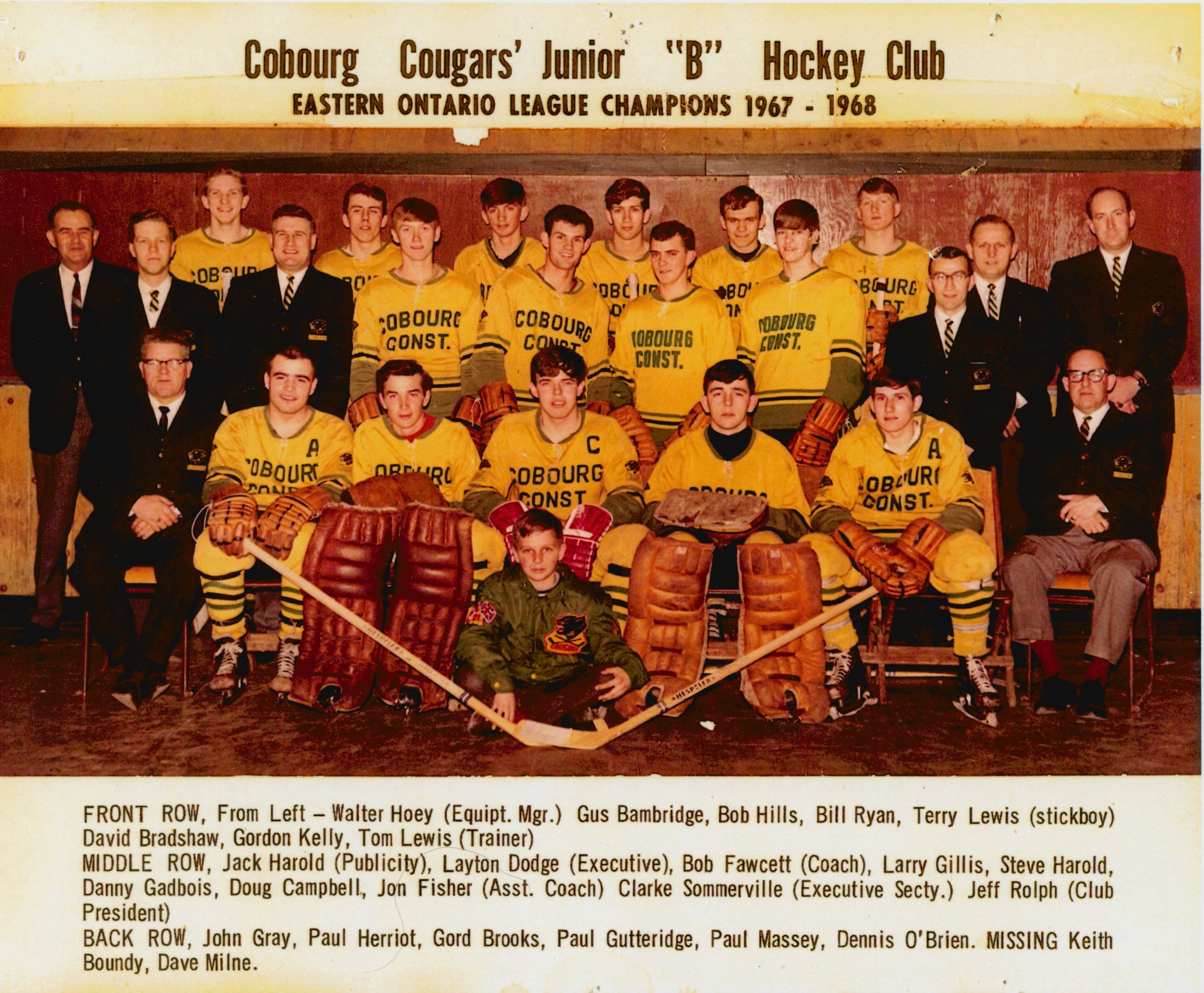
The Cobourg Cougars made their entrance onto the hockey stage in the fall of 1965 joining the Eastern Ontario Junior B Hockey League. Community minded businessmen, Clarke Sommerville and Jeff Rolph, provided the means to put the team on the ice while Ken Medhurst and Dick Robinson provided the team leadership. The nucleus of players was recruited from Cobourg’s two-time OMHA Midget AA finalists.


Teams in this league included Oshawa, Trenton, Belleville, Kingston and Peterborough. Cobourg ended the season in sixth place with 4 wins, 3 ties and 23 losses. The top 5 Cobourg scorers were Brian Gillis (30 points), Brydon Elinesky (27 points), Gus Bambridge (24 points) Gord Kelly (22 points) and Bill Ryan (18 points).

Goaltender, Rick Austin, faced an average of 37.2 shots per game. It was a tough inauguration but better days were ahead. Age, experience and recruiting would all play a part in the coming fortunes of the team.


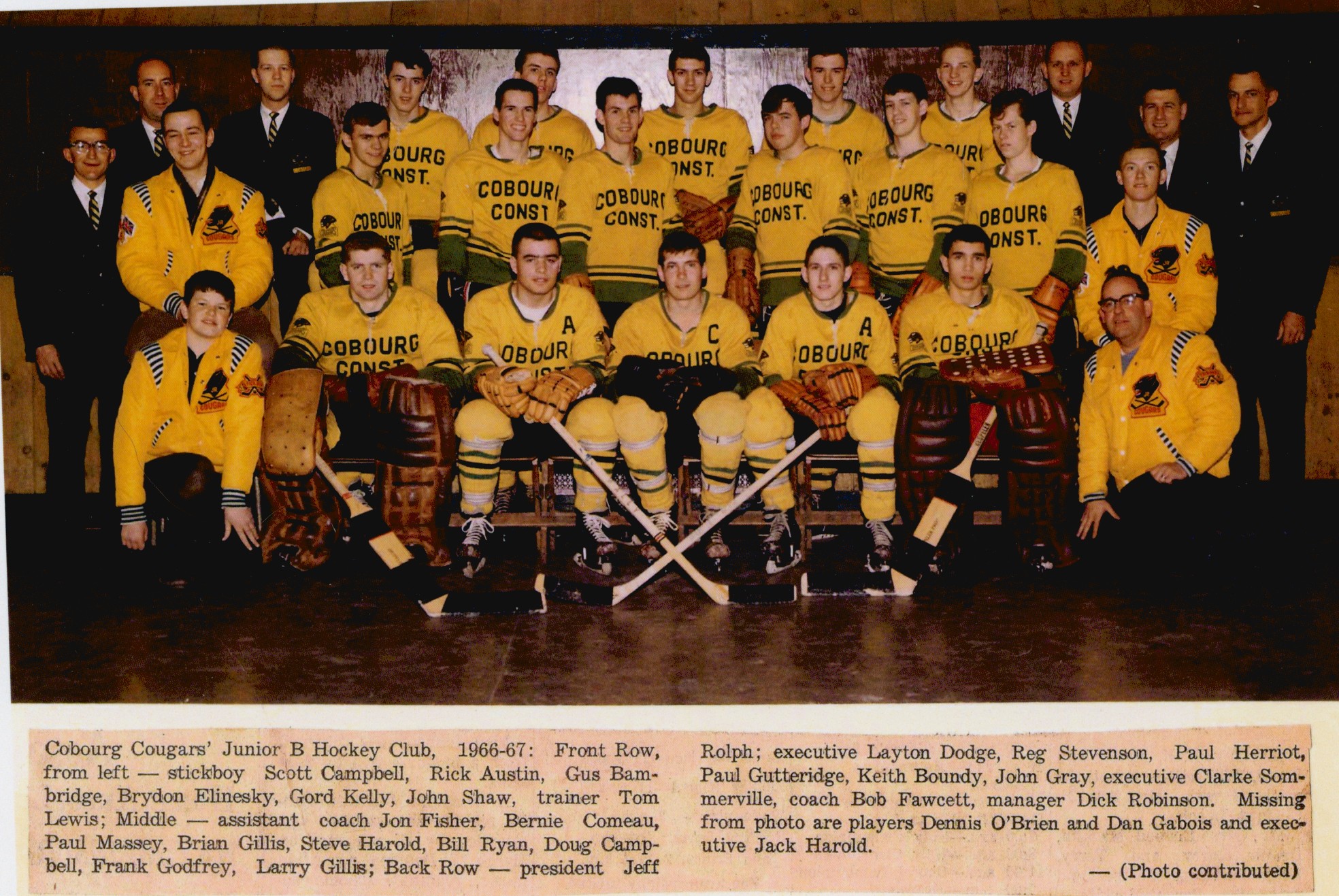
The 1966-67 season saw the Cougars achieve 40 points over the 30 games schedule with 19 wins, 7 losses and 2 ties. Leading the scoring parade that year was Gord Kelly with 59 points followed by Brydon Elinesky, Brian Gillis, Steve Harold and Paul Herriot.

With two seasons under their belt, the Cougars made their mark during the 1967-68 season. Finishing first in the regular season with a record of 19-9-4, the team was eliminated in the group final by the Oshawa Crushmen.

Average attendance at the Cougars home games was over 900 and 3500 fans took in the group final at the Oshawa Civic Centre. Gord Kelly continued his scoring magic, finishing the season with 83 points while John Gray followed with 80 points. It is notable that John Gray, Gord Brooks and Dennis O’Brien all went on to have careers in pro hockey.


Paul Gutteridge was the leading scorer for the Cougars in the 1968-69 season with 55 points followed closely by four-year veteran, Gus Bambridge with 54 points. The Cougars ended the regular season with a record of 12-16-2.

Alan Fenton would go on to complete a hockey scholarship at Colgate University while Mike Kelly has had a long and storied career with the OHL Guelph Storm, the OHL Windsor Spitfires and the Italian national hockey team. To read more about Mike Kelly’s hockey career check under 'Stories' on the cdshf.ca website.


After a pro hockey career, Ron Smith returned to his hometown of Port Hope where he served as a councillor and Mayor. Larry Thompson, who had 32 points on the season, went on to play the next two years with the OHL’s Niagara Falls Flyers and the Oshawa Generals.

Gus Bambridge has continued to contribute to hockey through his many years as a linesman, referee, supervisor of officials and instructor for the OHA, OMHA and OHF. In 2004, Gus received the Ontario Hockey Federation’s Officiating Award for contribution to the game, officiating skills and what they put back into amateur hockey within the branch.


With the loss of key personnel, the Cougars experienced some tough times, finishing the 1970-71 season with a record of 7-15-4. During this last Junior B season, the top scorers were Bruce Sherwin, Peter Kelly and John Lunn. Topping the charts in penalty minutes were Ray Bevan (142), Kevin Lowe (122) and John Lunn (112).


With the realization that interest was decreasing and costs increasing, the Directors determined that participation in the Central Ontario Junior C league was a viable option in hopes of making the team more competitive. 
 

COBOURG COUGARS CELEBRATE 50 YEARS

1965/66 – 2015/16

On January 28, 2016, the 1965 Cobourg Cougars were honoured and celebrated by the Cougar faithful and the OJHL at a red-carpet pre-game ceremony by the present-day cougars wearing replica jerseys of that inaugural season. A reception was held prior to puck drop which included a meet and greet with coffee and cake, distribution of replica jerseys, anniversary pucks and ball caps plus a copy of the original team photo. Members of the ‘65 Cougars present were: Coach Ken Medhurst, Frank Godfrey, Bernie Comeau, Gord Kelly, Paul Massey, Gus Bambridge, Keith Boundy, Brian Gillis, Brydon Elinesky (C), Rick Austin, Eric Buttar, Bruce Nicholas, Reg Stevenson, Steve Harold, Gord Stevenson, Paul Herriot and special guest Gord Brooks. Not present were Bill Ryan, Doug Campbell and Scott Campbell.

Below are some articles written by the late Layton Dodge in the Cobourg Star (a predecessor to Northumberland Today) back in 1965.


This story by Layton Dodge was originally published Sept. 1, 1965

Plans are proceeding for Cobourg to return to the junior hockey wars after and absence of two years.  Last week it was announced, following much speculation, that Cobourg intends to apply for entry into the new Junior ‘B’ Hockey League which is in the works for eastern Ontario this winter.  Announcement of a junior club being formed came as no great surprise but the decision to seek junior ‘B’ instead of ‘C’ status caught most local hockey boosters off guard. If Cobourg is accepted--and club officials already have assurances from OHA convener Jack Devine of Belleville that there is nothing standing in the way of it at the moment--then they will join a newly-formed alliance with Whitby, Peterborough, Belleville, Trenton and Kingston. 

Directors of the fledgling Cobourg club are Jeff Rolph and Clark Sommerville. Dick Robinson will be the manager and Ken Medhurst the coach. Medhurst is reported to be looking for an assistant.  

The team, it has been learned, will be partially subsidized by Cobourg Construction. 

Manager Dick Robinson said Friday that the decision to go ‘B’ rather than ‘C’ stemmed from the shorter travelling involved. If Cobourg went ‘C’, they would be grouped into a league with Picton, Napanee, and Gananoque. Mr. Robinson also commented that it was the intention “to hang on to local ‘B’ possibles who might go elsewhere to play hockey.”

Nucleus of the team will be personnel from the Cobourg Midget teams that reached Ontario finals the last two years. However, all players in the Cobourg-Port Hope area will be welcomed to tryouts, tentatively scheduled to get under way the early part of October. Most of Cobourg’s home games will be played on Mondays.  


This story by Layton Dodge was originally published Sept., 22, 1965

Cobourg officially became a member of the enlarged Eastern Ontario Junior ‘B’ Hockey League Monday night.

A four-man delegation--consisting of manager Dick Robinson, coach Ken Medhurst and directors Jeff Rolph and Clark Sommerville--attended a meeting in Belleville and, after hearing what both the ‘B’ and ‘C’ leagues had to offer, came to the conclusion that they had no other alternative but to go ‘B’ this season.

Cobourg officials decided to apply for a ‘B’ franchise several weeks ago but in the past weeks there were indications that they had a change of heart and would drop back into ‘C’ instead. However, that was ruled out as geographically impossible at Monday’s meeting when they learned that Royal Military College in Kingston and either Madoc or Stirling were possibilities in the ‘C’ setup along with Gananoque, Napanee and Picton. 

The local juniors will play in a group with Kingston, Belleville, Trenton, Peterborough and Oshawa. 

There was quite a hassle over the length of the schedule, Oshawa’s Wren Blair leading the argument for a 40-game slate. He was supported by Trenton and Kingston representatives.  

Cobourg, Belleville and Peterborough held out for a shorter 30-game calendar. It was finally resolved when the latter three teams agreed to play two 4-point games, one at home and one away, with each other. They will each play a total of 30 games, meeting each opponent six times. 

Oshawa, Trenton and Kingston settled on a 34-game schedule with no 4-pointers. They will play an extra home and home series with each other to make up the difference in points.  

The Cobourg team will have only two weeks to prepare for its league opener October 29 at Belleville since ice won’t be in here until the middle of next month. First home game will be November 1 against Quinte City club.  

ICE SHAVINGS - Group will play all-star game the first week of January with proceeds going to the OHA Emergency Fund... One outside referee and two local linesmen will be used for league contests... Top four teams will make playoffs. 


This story by Layton Dodge was originally published Oct. 6, 1965

Unlike the last Junior team which operated here for four years, the new Cobourg Junior ‘B’ Hockey Club will have its own special identity. 

The club officials, huddling last Tuesday night at the home of manager Dick Robinson to lay the groundwork for the 1965-66 season, decided that a catchy team name was desirable.  

It was thought that a nickname beginning with the letter “C” might be preferable since it would tie in nicely with Cobourg. The name “Cougars” was finally selected.  

The team management also decided to adopt at theme song, as yet unselected, as a means of raising team spirit. The record will be played every time the Juniors come on the ice for a game this season.  

Sweaters and socks already have been ordered. They will be basically yellow with green trim, the same colours associated with Cobourg Construction which is partially subsiding the team.  

A slate of officers was drawn up as follows: Jeff Rolph, president; Clarke Sommerville, secretary-treasurer; Dick Robinson, manager; Ken Medhurst, coach; Tom Lewis, trainer; John Lavis, special promotions; Layton Dodge, Dick Robinson, publicity; Larry Windover, assistant coach; “Vince” Massey, equipment manager. 

With the team’s proposed budget at over $2,800 and receipts likely to be around $800 short of that figure, it was decided to promote a 50-50 raffle in the hopes of raising most or all of that amount. 

Season tickets will go on sale shortly for $10 apiece, entitling the holder to 15 admissions during the regular schedule. 

All players who make the team will be given medical examinations by Dr. William Page before the first league game October 29 in Belleville. As another safety precaution, head helmets will be a compulsory club rule. 

Cobourg juniors will play in a league this season with Oshawa, Peterborough, Belleville, Trenton and Kingston.


This story by Layton Dodge was originally published Oct. 27, 1965

Cobourg’s own space shot into an unknown, unexplored world of Junior B hockey will be launched Friday night at Belleville. 

All systems are A - OK for the flight takeoff of Cobourg Cougars. Their only goal at the moment is that the four - month journey will end in a happy landing. 

Hometown boosters will get their first look at Cougars in orbit in the 6-team Eastern Ontario Junior B Hockey League Monday night at 8 o’clock when Belleville plays the return game at Cobourg Arena. 

The opening home and home series is an important one since both games are four - pointers. A sweep for either club would skyrocket it into a quick lead in the race.  

Cougars have 22 players signed to date. Latest to affix their signatures to playing contracts are goalie Ron Sedgwick, winger Bruce Nicholas and centre Gord Kelly of Cobourg, along with centre Brydon Elinesky and leftwinger Brian Gillis of Millbrook. 

They join Rick Austin, Keith Boundy, Roger Johnson and Gary Etcher of Port Hope, Doug Campbell, Paul Massey, Steve Harold, Gus Bambridge, Bill Ryan, Gord Stevenson, Lyle Manion, Reg Stevenson, Paul Harriot, Frank Godfrey, Eric Buttar, Bernie Comeau and Phil Kulas of Cobourg in the fold. 

Manager Dick Robinson announced over the weekend that he has made arrangements with Oshawa’s Wren Blair to play one of Cougars’ away games with Oshawa in Cobourg. It will be played here election night, November 8, instead of at Bowmanville, November 7. 

TIDBITS -- Cougars’ new green and yellow sweaters and socks won’t be here in time for the opener . . . Training School employee is making a stencil for Cougar emblem which will be painted on the ice in the centre face off circle. . . Alouette Football Club theme song will be adopted by Cougars and played at all home games.


This story by Layton Dodge was originally published Nov 1, 1965

Cobourg Cougars lost their opening game of the Eastern Ontario Junior B Hockey League at Belleville Friday night as expected but they looked better than expected doing it. 

While there is no denying Cougars succumbed 9-4 to the home side, most of the players and the management felt the score should have been closer and expressed confidence they would give the Quinte team much stiffer competition the next time out.  

In fact, had it not been for an off-night by goalie Rick Austin, this first meeting would have been a tight fit. Austin, in uniform despite a 3-day attack of dysentery, let 3 goals by him that he ordinarily would have stopped with one hand tied behind his back. 

Cougars played in fits and starts. They appeared quite jittery early in the contest when Belleville roared into a 3-0 lead inside of 5 1/2 minutes. Cobourg carried the play in the last half of the first period, slumped again in the early minutes of the second session, more than held their own in the latter half, then continued the same trick-or-treat pattern in the third canto.  

It was 4-1 Belleville at the end of the 1st period and 6-2 entering the third. The win was 4 points to Stu Muirhead’s charges. 

The line of Steve Harold, Gord Kelly and Paul Massey was Cobourg’s chief offensive threat. Massey, one of the smallest players on the ice, also was one of the best. He turned in an outstanding performance, skating hard, checking tenaciously, staying in position and scoring a goal. 

Harold was almost as effective. His efforts were awarded early when he combined with Kelly for Cobourg’s prettiest goal of the night. Kelly also set up Massey’s marker in the final stanza. 

Reg Stevenson was the pick of the defencemen, being particularly adept at blocking shots. The unluckiest blueliner had to be Doug Campbell. He lost another front tooth when clipped by a Belleville stick in the initial frame and had to retire for the rest of the night. It was his second such unfortunate experience this season. 

Belleville’s Mr. Everything was Bob Boyle. He personally destroyed Cougars with 4 goals and 3 assists. Carl Boomhower gave him a run for his money with 2 goals and 3 helpers. Peter Fleming added a pair of goals and Steve White a single. 

Cobourg fell behind 3-0 almost before they knew the game had started, Boyle, Boomhower and White blinking the light by the 5:26 mark. Cougars came storming back and Steve Harold, after a neat relay with Kelly, picked the far corner perfectly with a partly screened 25-footer at 11:43. Fleming got it back before the period expired while Cougars’ Gus Bambridge served a foolish high sticking penalty. 

Fleming and Boyle clicked 2 minutes apart in the 2nd for Belleville before Eric Buttar took a long lead pass from Roger Johnson, used line mate Paul Harriot as a decoy and cashed his own rebound for Cougars’ 2nd goal at 17:26. 

Boyle completed his handy work early in the third for an 8-2 Belleville advantage. Cougars kept battling and were rewarded with 2 goals in a 7-second interval. Massey triggered the first one after Kelly gained possession of the puck on the backboards; and Gord Stevenson on a fine passing play involving Brydon Elinesky and Gus Bambridge, slapped in a low 12-footer for the other. Boomhower’s drive that caught the top corner of the Cobourg net at 18:56 wound up the scoring. 

The game was exceptionally clean as Junior games go and expertly refereed by Dave Smith of Trenton. He gave the losers 4 of the 10 penalties, including a misconduct to Gord Kelly in the closing chapter for talking out of turn. 


This story by Layton Dodge was originally published Nov. 3, 1965

Rich man, poor man, hockey men, thief; doctor, lawyer, writer, chief.

They all said Cobourg didn’t stand a chance in the Eastern Ontario Junior B Hockey League this season.

Ken Medhurst’s hustlers made them all look bad Monday night in their home opener by skating off with an impressive 8-2 four - point victory over Belleville to the amazement and obvious appreciation of 300 fans.

It was a time when Cougars went the rest of the world one better. Instead of turning their watches back one hour Sunday, they held off 42 hours, then moved them ahead several months and cleaned Belleville’s clocks. 

Cougars weren’t supposed to be so good so soon. Yet they were. Bigger than life, giving Belleville a real going over on the scoreboard avenge a 9-4 setback in the Quinte City three nights earlier. 

Cobourg, hiking both ways at top speed between the opening faceoff and the final buzzer, tormented Belleville goalie Wayne Brant with a variety of 48 shots. Cougars rolled with the checks, played it smart and made everybody sit up and take notice. 

There were few weak links in the Cobourg armament. The strongest link was the line of Brian Gillis, Brydon Elinesky, both from Millbrook, and Gord Stevenson. They went together like ham and eggs. Ever dangerous on the attack and always persistent in the backchecking department, they set the pace and the trend of this eye-opener. 

The same trio opened the scoring in the 16th minute of play with a picture goal. Gillis started it in his own end, stickhandled past one defender and fired a rink-wide pass to Stevenson, who dropped the puck to Elinesky. Brudon shot a pass into the goalmouth and Gillis was there to tip it in. 

The score was still 1-0 when the two Millbrook boys combined again at 8:08 of the middle stanza. Gillis outbattled two Belleville men for the puck on the backboards, slipped the puck out front to Elinesky who blazed away from point blank range. The rubber dropped loose in the crease and Gillis tucked it home.  

Gus Bambridge made it 3-0 at 11.33 when he banked Reg Stevenson’s relay off the goalie’s skate into the net. The count jumped to 4 to nil just over 3 minutes later as Paul Harriot flicked in Bill Ryan’s rebound after Bambridge got the puck back to the point.  

In the 3rd period, Steve Harold picked the bottom right corner at 2:26, Gord Kelly and Paul Massey assisting, and Gord Stevenson cashed Gillis’ corner pass out at 4:19, after Doug Campbell had originated the play, to increase the margin to 6-0. 

Goalie Rick Austin, having a fine night guarding the Cobourg twine, lost his shutout bid at 12:09 when Doug Potts soloed while the teams played 5 aside. Grant Hagerman clicked again for Belleville moments later with Cougars shorthanded.  

Cougars got those back before it was all over. Paul Massey converted relays from Ryan and Kelly at 14:04, and Bambridge went it alone at 19:54.  

Sixteen penalties, 10 to the visitors, were assessed by referee John McFadden of Peterborough. 

COUGAR NOTES -- Three stars were Gillis, Austin and Gord Stevenson in that order . . . Cobourg owned a 48-30 shooting margin . . . Last 45 minutes of game were broadcast over the local radio station. This will be a weekly practice . . . Next Monday, Oshawa Crushmen play here at 8.pm.


Sport Team or Name This Story is about

Add new comment

Restricted HTML

  • Allowed HTML tags: <a href hreflang> <em> <strong> <cite> <blockquote cite> <code> <ul type> <ol start type> <li> <dl> <dt> <dd> <h2 id> <h3 id> <h4 id> <h5 id> <h6 id>
  • Lines and paragraphs break automatically.
  • Web page addresses and email addresses turn into links automatically.
CAPTCHA
This question is for testing whether or not you are a human visitor and to prevent automated spam submissions.

Hockey-Mike Kelly

OHL 20 in 20 Summer Spotlight: Mike Kelly leaves a legacy

OHL 20 in 20 Summer Spotlight: Kelly leaves a legacy

by Josh Sweetland August 12, 2017

With Permission of OHL and Guelph Storm

A respected builder in the Ontario Hockey League over a span of 20 seasons, Mike Kelly is taking time to slow down and enjoy time with his family.

A grandfather of four with grown sons living in the Niagara region, Kelly stepped down from his post as general manager of the Guelph Storm this past spring in an effort to prioritize more time with the little ones. He and his wife currently spend their time between Niagara-on-the-Lake, Fort Erie and their summer dwelling in the Kawarthas.

“I decided it was best to step back and invest some time in my grandchildren,” said Kelly, who led the Storm to an OHL championship in 2014. “I’m certainly open to future opportunities in the game, but perhaps ones that are a bit less demanding than being a general manager.

“I’ve really enjoyed the time I’ve been able to spend with my family this summer.”

Originally from Cobourg, Ont., Kelly became the first general manager in Guelph Storm franchise history in 1991 after time around the game that included playing at the University of Buffalo and serving as an assistant coach there until 1977. He was also the head coach of the men’s hockey program at Canisius College from 1977-80 and coached Italy’s National Men’s Hockey Team on two occasions during his coaching tenure there from 1983-91.

He had a hand in the development of eventual NHL talents in Jeff O’Neill, Todd Bertuzzi, Manny Malhotra and Robby Fabbri with the Storm in addition to Jason Spezza, Steve Ott and Tim Gleason during his time with the Windsor Spitfires from 1999-2005.

After 20 years in the league, Kelly was quick to extend thanks to a number of people who supported him along the way.

“Jim Rooney and John Heeley, two of the original owners of the Guelph Storm were very supportive of me during those early stages when we started with a nine win season,” he noted. “Eventually we became one of the best teams in the league, going to three OHL Championships in a four year span thanks to the great work of men like (head coaches) Craig Hartsburg, E.J. McGuire and George Burnett.”

“I had the pleasure of working with Tom Webster in my four years in Windsor,” Kelly continued. “I certainly had a lot of respect for his professionalism and manner of handling a junior hockey team.”

“Additionally, Commissioner David Branch has been a mentor and supporter throughout my time in the league and I’m very thankful for the great job he has done.”

OHL Commissioner throughout Kelly’s tenure in the league, Branch was quick to echo words of gratitude.

“Mike Kelly’s personal values clearly carried over in the way he conducted himself in terms of always providing support to the players and families that have been involved with the programs he oversaw,” said Branch. “Mike was one of our leaders in bringing forward thoughts and ideas, supporting any number of league initiatives to continue to provide positive change to the game and our player experience.

“I hope to see Mike return to the league in some capacity down the road so as to continue making valued contributions to our great game.”

Kelly served as an OHL representative during the 2006-07 season, standing in as Governor and head coach of the Mississauga IceDogs. It’s there, in the only full season he coached, that Kelly enjoyed a memorable career experience in contributing to the development of a young  Luca Caputi who currently serves as an assistant coach with the Storm.

“Luca was an 18-year-old late birthday going into his draft year who hadn’t had much success in his first two seasons in the league,” Kelly recalled. “He really blossomed that season and I think that had a lot to do with his confidence level. I certainly found it satisfying telling a player like that, who maybe didn’t think it was ever going to happen for him, ‘hey, stick with it, you’ve got something pretty special here.'”

Caputi went on to score 37 goals that season and was selected by the Pittsburgh Penguins in the fourth round of the 2007 NHL Draft. He returned to score 51 goals and record 111 points in 2007-08 before embarking on a five year pro career that included 35 games in the NHL.

Another of Kelly’s favourites over the course of his 20-year career was former Guelph Storm captain Chris Hajt, a Buffalo native who recently accepted an assistant coaching position with the Buffalo Sabres. Kelly chose Hajt in the third round of the 1994 OHL Priority Selection and the big defender would contribute to three trips to the OHL Final, helping the Storm hoist the J. Ross Robertson Cup for the first time in 1998.

“That one’s certainly a feel good story,” said Kelly. “I don’t think many people knew of Chris when he was playing in Buffalo, but he turned out to be a very important part of the organization’s success, not to mention he is one of the most outstanding people in the world. It’s great kids like that who have kept me enthralled and loving junior hockey – it’s all about the kids.”

Kelly turns the Guelph Storm over to George Burnett, a 20-year OHL coaching veteran who served as general manager of the Flint Firebirds last season. It was Burnett who took over head coaching responsibilities with Guelph in 1997 when Kelly took a position as Director of Amateur Scouting with the Calgary Flames. Burnett and general manager Alan Millar (now of the WHL’s Moose Jaw Warriors) led the Storm to their first OHL title.

This time around Burnett will take over as both head coach and general manager, and Kelly says the organization is in good hands.

“I’ve had the privilege of working with George for a long time, and I’m thrilled that he’ll be overseeing operations with the Guelph Storm,” said Kelly. “I respect his values and I really like what he stands for. I think he’s a heck of a role model for young people and a very accomplished coach and general manager.”

Though Kelly’s days as a general manager are likely behind him, a love for the game and assisting in the development of junior hockey players on and off the ice will have him back in the rinks soon enough.

“Oh I’m sure I’ll be back at it in some way eventually,” he finished. “Give it a few months time and I’ll start reviewing to see if there’s something out there that makes sense.”

NB: Mike Kelly is a Cobourg native and was a member of the Cobourg Cougars Junior B hockey club during the 1968-69 season.


Sport Team or Name This Story is about

Add new comment

Restricted HTML

  • Allowed HTML tags: <a href hreflang> <em> <strong> <cite> <blockquote cite> <code> <ul type> <ol start type> <li> <dl> <dt> <dd> <h2 id> <h3 id> <h4 id> <h5 id> <h6 id>
  • Lines and paragraphs break automatically.
  • Web page addresses and email addresses turn into links automatically.
CAPTCHA
This question is for testing whether or not you are a human visitor and to prevent automated spam submissions.

Softball-Cobourg Town League 1962-2010

1974 COBOURG MEN'S TOWN LEAGUE SOFTBALL CHAMPS

          COBOURG TOWN LEAGUE
 

                   TABLE OF CONTENTS

   Career Batting Leaders  ……………………….    3

   Career Pitching Leaders ……………………….   6

   Town League Awards & Champions ………..  8


   Yearly Statistics & Reports
   2002 ……………………………………………….   13
   2003 ……………………………………………….   26
   2004 ……………………………………………….   42
   2005 ……………………………………………….   60
   2006 ……………………………………………….   64
   2007 ……………………………………………….   70
   2008 ……………………………………………….   74
   2009 ……………………………………………….   78
   2010 ……………………………………………….   86


                                                     Career Battings Statistics for Active Players 1  …….  90

                                                     Career Pitching Statistics for Active Players 2 .……. 171

                                                     All-Time Batting Statistics – All Players …………….. 188

                                                     All-Time Pitching Statistics – All Players     ………… 215


                                                          1 Includes all players Active in the last 5 years plus anyone with 500 Careers AB’s

                                                                    2 Includes all players Active in the last 5 years
 

    Download 223 Page PDF 1962-2010 CTL Stats & Awards


Sport Team or Name This Story is about

Add new comment

Restricted HTML

  • Allowed HTML tags: <a href hreflang> <em> <strong> <cite> <blockquote cite> <code> <ul type> <ol start type> <li> <dl> <dt> <dd> <h2 id> <h3 id> <h4 id> <h5 id> <h6 id>
  • Lines and paragraphs break automatically.
  • Web page addresses and email addresses turn into links automatically.
CAPTCHA
This question is for testing whether or not you are a human visitor and to prevent automated spam submissions.

Softball-Women:1987-2017

2010 Cobourg Angels

By Patsy Currelly Hand

Cobourg Angels, Junior Angels, & Surrounding Teams 

1987 was a very successful year for the Angels.  With the loss of a few players and the addition of a few, the Angels were successful in acquiring another Ontario Senior Tier II championship vs. Sarnia.  Devlin pitched all games during the championship with 30Ks, 6 walks. The team were finalists in Senior Tier I with Elaine being named MVP pitching 43 innings. The team also were Metro League Champs.  Members of this team were:  Nancy Cronin, Patsy Currelly, Suzanne Morrow, Leah Anne Oulahen, Jacki Oulahen, Elaine Devlin, Barb Snedden, Jackie Dusenbury, Nancy Jane Dalgarno, Lynn Tracey, Debbie Gillis, Jennifer Dalgarno, Vicki Wodzak, Coaches: Ray Bickle, Jim Morrow, John Hayden, Scorer Sharon Greavette. 

As Paul Currelly was not on the field with the Angels, he along with veteran Angels, Faye Gaudet, Jan Bradford, current Angel Suzanne Morrow and Bill Zinkie formed the Cobourg Junior Angels.  This gave girls an opportunity to play rep ball in the squirt, novice, bantam, midget and juvenile division.  The current Angels put on clinics to teach girls the basics.  Paul spearheaded a new league, the Lakeshore Girls Softball Association and contacted centres along the lakeshore for the Cobourg girls to compete with.  This organization continues today and has grown to include house league teams.  

1988 brought with it many changes. The team moved up to Senior Tier I and played in a league which included teams from Chinguacousy, Cedar Hill, Agincourt, Richmond Hill, Pickering, Bramalea, Tonawanda (New York), Dorchester, St. Clements, Oakville, Kitchener, and St. Catharines.  Many weekends were spent on the ballfield playing double headers with the western teams.  Sandy Claus pitcher/player/coach joined the coaching team as well as Art Dalgarno (scorer).  

Paul Currelly returned to coach first base, Morrow on third.  They were Ottawa tournament champs and led their division throughout the year.  In the Tier I Ontario championships they went to the finals and lost to Oakville 4-2. Elaine Devlin was MVP at this tournament and was subsequently picked up by Oakville to go to the Canadians in Newfoundland.  She had an ERA of 0.64 over 42 innings. 

1989 marked the end of an era.  The team did well, winning the Milverton Classic Tournament, they ended up 2nd in the Senior Tier I league.  Elaine was picked up by BC to go to a New Zealand International Tournament and Jackie Oulahen got a tryout with the Canadian National team to represent Canada at the worlds, however it was not to be as she fractured her finger before tryouts. As a team, things started to break down off the field. During the season, Patsy and Paul Currelly decided it was probably going to be their last year. They didn't announce this so no one else on the team really knew. 

At the end of the season, a group of players decided that they weren’t happy with the direction the team was going and a handful of players called a player meeting to voice their opinions about their desire to invoke a staff change. As with many successful teams, individual egos can cloud good judgment and greed can replace gratitude. Comments were made that did not “sit well” with everyone.  The result was the Currelly’s followed through with retiring from the team. Jim Morrow and John Hayden followed.  Others left the team, too, including star pitcher, Elaine Devlin. The players were left without a coach and without enough players to field a team. 

Fortunately for them, the 1990 season progressed somewhat as planned.  Harnden and King agreed to sponsor the team.  A team from Scarborough coincidentally named the Angels had folded due to lack of players and they contacted the Cobourg girls to see if they could join forces.  Charlie Fraser stepped into coach as well as ex-Angel Marg Matthews, and former Angel pitcher Janice Crosgrey returned. The team did well and played in the Senior Tier I loop for regular season play and were able to capture the Ontario Senior Tier I Championship and went to the Canadians finishing 5th overall.  

Members of this team were:  Teresa Hutchison, Tami Waters, Su Morrow, Nancy Jane Dalgarno, Jennifer Dalgarno, Kirsten Leis, Nancy Cronin, Marilyn Lang, Jackie Dusenbury, Jackie Oulahen, Isobel Nichols, Janyce Gunn, Barb Sneddon, Janice Crosgrey, Sherry Hoffman. (Mary Jo McCarthy, Lyn McMahon, Wendy Dobbin and coach Marg Skillen were picked up for the Canadian Championships). At provincials, Isabel Nichols was the batting champion and Jackie Oulahen was named MVP. The Senior Angels continued for the 1991 season and competed in the Senior Tier I league but due to lack of players they folded after that season. 

The Junior Angels organization however picked up the torch.  1990 was an amazing year for the Sophomore Junior Angels coached by Paul Wakely and Henry Heideman.  Having gone to the finals in 1988 and 1989, they successfully won the Ontario title vs St. Catharines .  Marianne McMillan was the tournament MVP batting .471. Members of this team were: Marianne McMillan, Launa Foreman, Christina Winkworth, Tracey Davis, Lorrie Calbury, Lori Hibbard, Dianne Gray, Charlene Winkworth, Kelly Moore, and Karen Rose.

1992 saw the coaching duo of Paul Currelly and Jim Morrow reunite on the field to coach the Junior Angels Wimpy Mineral Intermediate team and later the Morrow Transport Intermediate Angels, along with coach Bryan Rose.  They continued to coach together until the 1995 season.  

1994 brought another Ontario title home to Cobourg.  The Jr. Angel Junior Tier II team coached by Pat Mowat were successful in capturing the title against Owen Sound.  Kristen Buttars captured the top pitcher award in the tournament and Connie Sturzenegger was the top hitter batting .667, including 1 HR, 3 triples and 6 singles.  Members of this Ontario Championship team were:  Kristen Buttar, Sharon Taylor, Connie Sturzenegger, Angie Adams, Anne Macklin, Janice McIvor, Racquel Nelson, Joanne Chadwick, Kelly Bax, Krissy Doherty, Kerri-Lee Dahmer, Ted Hook (coach) and Pat Mowat (coach). 

As time progressed and there was no longer a Senior Angel team, the “Junior” was dropped from the Angel team title.

2000 brought another Ontario title to Cobourg in Bantam Tier II, coached by Steve Jones, Joe Brouwers, Faye Gaudet and Greg Oulahen. The team beat Brampton in the finals and the team members were:  Amy Shannon, Stephanie Jones, Melissa Henke, Kristel Gallagher, Sarah Winter, Sarah Clarke, Julia Hayden, Liz Oulahen, Kelly Nalysnyk, Megan Brouwers, Dana Spicer, Karlee Haynes and Laura Burnham.   

In 2003, another Ontario Championship Gold medal was achieved by a Cobourg Angel team.  In the Midget category, the Angels defeated Ajax in extra innings to claim the title.  Members of this team were:  Arianne Allen, Alice Sutcliffe, Dana Spicer, Sarah Clarke, Amy Shannon, Stephanie Jones, Jessalyn Glinski, Sarah Winter, Kelly Nalysnyk, Dawn Armstrong, Erica Prins, Head coach Bill Shannon, Manager Susan Spicer, and assistant coaches Steve Jones, Andrew Allen, and Paul Currelly.

In 2008, 2009 and 2010 Dave Clarke’s Angels accomplished 3 consecutive Ontario Titles in Junior Tier II, a feat not previously achieved in the history of the Angels.  Members of this very talented team were in 2008:  Erica Dewey, Nicole Blake, Erin Dewey, Lisa Clarke, Allie Rutherford, Alex Oosterhof, Breann Coulson, Sarah Clarke, Sam Harrison, Christina Murchie, Taylor Cook, Coaches Dave Clarke, Steve Jones, Kerry McDonald and Angie Adams Darlinson (asst. coach).  

The 2009 team won four straight games to clinch their second Junior Tier II Ontario title.  Christina Murchie pitched all four games beating Halton Hills, Cambridge, Brampton and Ancaster. The highlight of the final game was an out of the park home run by Erin Dewey but it was her sister, Erica Dewey, who earned the tournament MVP.  This team included:  Erica Dewey, Nicole Blake, Erin Dewey, Lisa Clarke, Allie Rutherford, Gina Maloney, Sam Harrison, Nikki Wilson, Christina Murchie, Taylor Cook. Head Coach Dave Clarke, coach Steve Jones, Assistant coach Sarah Clarke and Manager Kerry McDonald.  

2010 would bring yet another Ontario Junior Tier II title to this team.  An achievement yet to be matched by any Angel team, past or present.  The Angels would beat Brampton in the final by a huge margin of 12-5!  Team members were:  Allie Rutherford, Lisa Clarke, Nikki Wilson, Taylor Cook, Erin Dewey, Jess McIntyre, Erica Dewey, Christina Murchie, Julia Bateman, Gina Maloney, Nicole Blake, Sam Harrison, Coach, Dave Clarke, Steve Jones, Mike Murchie and Manager, Kerry McDonald. 

Most recently, the Cobourg Angels represented the Town winning the Eastern Canadian Softball Championship, Novice Tier 2 in 2017 and were coached by Faye Gaudet, Kate Reed, Kristen Lalande and Chris Lalande. Players included Amelia Pettipas, Reagan Lalande, MacKenzie Mamers, Braelyn Farrell, Megan Geurts, Taylee Herman, Grace Rice, Ava Hughes, Megan Sheehan, Macie Hackney, Lilah Klassen, Kaycee Craig, (Madison Depencier from the Chatham Eagles was picked up for the Canadians).  Depencier won the top pitcher and batting recognition but it was Cobourg’s Reagan Lalande who would win the overall MVP honours for the tournament.  

The Cobourg Junior Angels organization continues to this day with both house league and rep teams in the mite to midget division.  What began as a dream for one man has flourished into an organization where girls not only learn and enjoy the game of softball but discover the importance of sportsmanship, teamwork, fair play and a positive work ethic, building self-esteem and confidence.  

Many, many Angels have returned to the ball field to pass these values to the next generation either as a coach, a manager, scorekeeper, executive member or supporter. The positivity of sport continues.

Cobourg Angels
1987      Ontario Senior Tier II Gold medalists vs Sarnia, Ontario Senior Tier I finalists vs Dorchester. Ontario Regional Gold Medalists vs Belleville, Metro League Champions.
1988      Ontario Senior Tier I Silver Medalists vs Oakville, Ottawa Tournament Champions
1989      Eastern Division Senior Tier I League Champions, Milverton Classic tournament champions vs St. Catharines
1990      Ontario Senior Tier I champions 

Cobourg Junior Angels Ontario Champions 1990-2020
1990      Ontario Sophomore (previously Juvenile) Championship
1994      Ontario Junior Tier II Championship
2000      Ontario Bantam Tier II Championship
2008      Ontario Junior Tier II Championship
2009      Ontario Junior Tier II Championship
2010      Ontario Junior Tier II Championship
2017      Eastern Canadian Novice Tier II Championship

Updated August 2020

Sport Team or Name This Story is about

Add new comment

Restricted HTML

  • Allowed HTML tags: <a href hreflang> <em> <strong> <cite> <blockquote cite> <code> <ul type> <ol start type> <li> <dl> <dt> <dd> <h2 id> <h3 id> <h4 id> <h5 id> <h6 id>
  • Lines and paragraphs break automatically.
  • Web page addresses and email addresses turn into links automatically.
CAPTCHA
This question is for testing whether or not you are a human visitor and to prevent automated spam submissions.

Softball-Women:1968-1986

1985 Cobourg Angels

By Patsy Currelly Hand

Cobourg Angels, Junior Angels, & Surrounding Teams 

It was the dream of an avid sportsman, a man named Paul Currelly – to one day see “top notch” women’s softball in Cobourg.  The dream started small with his first team, the Coverdale Aces, in 1963.  They had great success and a bantam team was formed in 1964, the Coverdale Angels.  As the girls got older and the town league began to form, Paul saw an opportunity to put Cobourg on the softball map.  

He combined the two teams, taking the colours (green and gold) from the Aces and the name of Angels from the bantam team.  He recruited top players from the existing Cobourg District Town League, landed two co-sponsors, Harnden and King Construction and Burley Bus Lines and formed the first Cobourg Angels team.  

They were entered as Juveniles (under 16) in the Durham County Ladies Softball League.  The first coaches were Gord Burdick, Ev Walters and Currelly.   They fared well in their first year, playing Intermediate teams from Port Hope, Newcastle, Courtice, Bowmanville and Whitby and they advanced to the finals but lost to Port Hope.  In their Provincial Juvenile C playoffs they made it to the semifinals.   Members of the first team were:  Nancy Currelly, Carol Currelly, Jackie Keeler, Anne DesMarteau, Brenda Lemmon, Dianne Stacey, Maxine Smith, Maureen Smith, Connie Byrne, Peggy Kernaghan, Janice Bevan, Nancy Brooks, Janice Rowe, Candace Cane. 

In 1969, Cobourg’s Martin Sunoco Intermediate team coached by Huck Matthews joined the league.  The Angels won the league during regular play but it was the Intermediates who won the play-offs that year.  The Martin Sunoco team would go on to win several Durham County Crowns and went to the Intermediate B semifinals – key players on that team were:  Judy Bevan, Judy Bowen, Helen McAlpine, Sylvia Hall, Doris Matthews, Cheryl Batley, Carol Currelly, Brenda Cochrane, Mary Hoy, and Sue Reynolds.  In 1970, the Angels were finalists in both the league and the Juvenile A provincial finals.

1970 marked another important girl’s softball event in Cobourg. Ken Petrie and Audrey Warner’s Martin Sunoco team won the first Ontario Minor C championship held by the Provincial Women’s Softball Union of Ontario (PWSU).  Members of this team were:  Eve Fenton, Donna Dolley, Barb and Darlene Warner, Kim and Sue Gallagher, Lee Cane, Faye Oliver, Carol Jones, Mary Checkley, Joanne Drury, Debbie Cochrane, Joanne Ferguson, Theresa Callaghan, Cindy Newman, Sandy Vorvis, Lori Dowle, Nancy Wielonda. 

The Angels continued to play in the Durham County league in 1971 adding Jeff Brooks to the coaching staff. In 1972, the Harnden and King Angels entered the Lakeshore Juvenile League with teams from Oshawa, Ajax, Claremont, Whitby and Port Perry. The Angels won this league in both 1973 and 1974.

1972 also saw Cobourg Sinclair Mustangs under Clarke Sommerville, David Sommerville and Don Dunn defeat Oshawa to win the 1st PWSU Ontario Squirt Championship.  Members of this excellent club were Marg Matthews, Chris Gallagher, Tracey Bourne, Nancy Sommerville, Julie Gallagher, Julie Nairn, Elaine Warner, Janice Thompson, Wendy Stewart, Regan Lewis, Lori Dolley, Theresa Karpinski, Sharon Oakman and Roberta Fisher. 

Girls’ softball was flourishing with the YMCA/YWCA operating a town league that at one time had up to 22 teams, including PWSA teams.  Others prominent in this league were Don Dunn, Keitha Rollings, and Ken Petrie who also operated the Cobourg Saints, very successful Midget and Juvenile teams. 

1975 & 1976 saw the Angels move successfully into the Junior B category.  Coached by Bill “Buzz” Foote and Paul Currelly, they were able to capture the Provincial Junior B championship in consecutive years.  This was one of Currelly’s top teams and they were:   Judy West, Joanne Jackson, Nancy Currelly, Judy Davey, Joan VanderZyden, Donna Todd, Peggy Jamieson, Faye Oliver, Marg Matthews, Sue Foote, Pat Richardson and Joanne Drury (1975), Tracey Bourne (1976).  This team won the Lakeshore League in 1975 and were finalists in 1976.

Ending on a “high note”, Currelly decided it was time to recreate the Cobourg Harnden and King Angels. His younger daughter Patsy was bantam age and because two of his players on the Ontario championship team, Marg Matthews and Tracey Bourne were still eligible to play Midget, he decided to enter a team in that category in the Lakeshore League. The year was 1977 and Bill Foote continued as coach, along with Currelly.  Jim Morrow joined the team that year and brought with him his larger than life personality.  

The Angels successfully won the league, the Claremont tournament and were provincial semi-finalists in Midget Tier II.  Members of this first team were:  Marg Matthews, Tracey Bourne, Patsy Currelly, Leah Ann Goody, Suzanne Morrow, Nancy Sommerville, Andrea Todd, Julie Godawa, Vikki Etchells, Carol Gutteridge, Rosemary Spry, Kathy O’Neill, Buttons Hogan, Bobbie Ann Hutchings, and Nancy Jane Dalgarno.  Moving up to Juvenile in 1978 they accomplished a record of 38 wins and 10 losses including tournament championships in Claremont and North York as well as going to the Juvenile A finals against Dundas. They also won the Grafton tournament against a respected Cobourg Tony’s Bantam team.  

The Cobourg Tony’s later to be known as Cobourg Oilers established themselves in 1976.  This club under the direction of Faye and George Oliver played 3 years as Bantams and 2 seasons in the midget category.  Their accomplishments were very extensive winning Lakeshore crowns, this league was under the direction of Ken Petrie and later Art Dalgarno.  In 1977, they won the PWSA Bantam B championship and in 1978 went to the finals, losing to Stratford.  

Moving up to midget in 1979 and 1980 they each won regional honours only to lose out in the finals.  The Ontario championship team included: Jackie Dusenbury, Jane Choiniere, Jackie Oulahen, Sandra Tuttle, Cathy Williams, Judith Curtis, Dianne Beatty, Ann Clarey, Jennifer Dalgarno, Cathy Dunn, Cathy Rowden, Susan Cane, Carolyn Darling, Connie Oliver, Elaine Warner and Donna Hutchings.

1979 would bring this Angel team their first All-Ontario Juvenile A Championship under the new PWSA system, winning the 14-team regional playdowns held in Cobourg and then the 9 team Ontario finals held in Rockwood.  With a season record of 50 wins, 7 losses, they were Lakeshore League champs as well as Trenton and Grafton tournament champs.  Members of the all-Ontario team were:  Marg Matthews, Suzanne Morrow, Sue Taylor, Bobbie Ann Hutchings, Patsy Currelly, Buttons Hogan, Nancy Jane Dalgarno, Tracey Bourne, Angie Quinn, Donna Hutchings, Nancy Sommerville, Leah Anne Goody, Vikki Etchells, Paul Currelly (coach), Jim Morrow (coach), Rod Baker (business manager) and Janet Hynes (scorer 1979-1983). Some of the Tony’s players would also play on this team during the regular season namely Jackie Dusenbury, Jennifer Dalgarno and Jane Choiniere.  

1979 saw girl’s softball flourishing in Cobourg:  The YMCA league had co-ed T ball, girl’s ball in the squirt, novice and juvenile divisions; rep ball teams were represented by the Sommerville’s bantams, the Tony’s midgets and the Harnden and King juveniles.  Traditionally, Legion ball was for boys but as the years progressed many talented girls played alongside the boys.  The Legion had teams in atom, squirt, peewee and bantam.

In 1980, the Angels moved up to the Junior division winning the Lakeshore title over rival Lakefield and were Carp tournament champions. In 1981, the Angels and Tony’s personnel combined, strengthening the team. During this season the infield went 100 plays without a single error! They were finalists in the Junior Tier I Ontario championships and Lakeshore League. 1982 added pitching coach John Hayden to the roster. The Angels won the Lakeshore League and Oshawa and Belleville tournaments and repeated as Belleville tournament and Lakeshore league winners in 1983.

1984 brought the first Senior Tier II Ontario championship to Cobourg (vs Waterloo).  The team ended the season with an impressive 44 wins, 6 loss record, including a 34-game winning streak. Highlights of this year included a third consecutive Belleville tournament championship as well as two pitchers throwing no hitters during regular season play, Suzanne Morrow and Elaine Devlin.  

By winning the Tier II championship, the team qualified to enter into the Senior Tier I Ontario Championships.  Although they finished 6th overall, their presence was known including an exhaustive 17 inning win (pitched by Devlin) against Agincourt. Harnden and King continued their 17th consecutive year as team sponsor. Members of the winning Ontario title team were: Susan Taylor, Nancy Cronin, Margie Matthews, Suzanne Morrow, Leah Anne Goody, Nancy Jane Dalgarno, Elaine Devlin (37-5 pitching record), Jackie Oulahen, Lee Anne Quinn, Jennifer Dalgarno, Isobel Nichols, Vicki Wodzak and Patsy Currelly. Paul Currelly, Jim Morrow and John Hayden were the coaches.

As there was no residency rule and the closest team east was Pickering, Currelly had the opportunity to further strengthen his team.  1985 saw a repeat of the 1984 roster with a few additions. Cathy Fertile, from Oshawa, who had played on many Senior Tier I teams, joined the squad. Janice Crosgrey, from Claremont, strengthened the team’s pitching and Lynn Lucas, from Belleville, added depth to the infield.  

Currelly would refer to this team as one of his best and they were successful in securing another Ontario Senior Tier II title.  Highlights of the final game versus Norwich included 2 out of the park home runs by Isobel Nichols.  Sue Taylor won the batting crown for the tournament with a .600 average and Devlin received an honourable mention. (Devlin allowed only 2 runs in 20 innings, walking 2 and striking out 18 for an era of 0.77).  The team continued their success by winning the Metro League Championship. Jackie Oulahen and Elaine Devlin were selected for the 1985 Junior Ontario team and played in the Summer Games in New Brunswick, winning a gold medal.  Elaine also received a softball scholarship to Sam Houston University in Texas.  

1986 saw a change at the helm of the Angels.  Veteran coach Paul Currelly stepped off the field due to health reasons but continued to work in the background.  Joining Morrow and Hayden was coach Ray Bickle. The team found themselves as finalists in both the Senior Tier II championship as well as at the Mildor Classic.  The highlight of the year was a no-hitter thrown by pitcher Janice Crosgrey. 

Cobourg Angels 1968-1990
1968      PWSA Juvenile Semi-finalists to Richmond Hill – Durham league finalists to Port Hope Knights.
1969      Durham County League winners
1970      Juvenile A finalists lost to Eringate. Durham County finalists lost to Cobourg Intermediates
1971      Juvenile A semi-finalists to Eringate. Durham County semi-finalists to Bowmanville
1972      Juvenile A semi-finalists to East Guildwood and Lakeshore Juvenile semi-finalists to Oshawa
1973      Juvenile A finalists to Burlington. Lakeshore Juvenile Champs over Port Perry
1974      Lakeshore Juvenile champs over Port Perry
1975      Ontario Junior B champs over Brookville – Lakeshore League champs over Lakefield
1976      Ontario Junior B Champs over Hillsbury – Lakeshore     finalists to Lakefield
1977      PWSA semi-finalists to Burlington, Lakeshore Midget champs. Claremont tournament champs
1978      North York Super series juvenile champs, PWSA Juvenile A finalists to Dundas, Lakeshore champs over Napanee, Claremont tournament champs
1979      Ontario Juvenile A champs over North Bendal,  PWSA regional champs over Glenfield and Lakeshore Juvenile champs over Oshawa Shamrocks, Trenton                          Tournament champs
1980       London tournament finalists to St. Catharines, Lakeshore Ladies fastball champs over Lakefield, Carp tournament champs.
1981      Belleville tournament finalists to Ottawa, Metro tournament finalists to Don Victoria, Junior Regional Bronze medal winners to Milverton, Junior finalist and silver medal winners to Oakville – Lakeshore Ladies fastball league finalists to Lakefield.
1982      Belleville tournament champs over Lakefield, Oshawa tournament champs over Toronto Stardex, Pembroke tournament consolation winners over Carleton Place.  Lakeshore ladies fastball league winners over Lakefield.    
1983      Belleville tournament champs over Oshawa MCL, Bronze medal regional winners at Belleville and bronze medal winners in Tier II finals in Barrie to Norwich. Fifth place at Senior Tier I to Mildor. Lakeshore Ladies Fastball League Champs over Belleville.
1984      Ontario Senior II gold medal Champions over Waterloo, gold medal regionals over Elmvale, Belleville Tournament Champs over Oshawa M.C.L. Seventh at  Senior Tier I championships to Kitchener. Metro League finalists to Toronto Spartans
              Record 34 wins in a row to start season.
1985      Ontario Senior Tier II gold medal Champions over Norwich, Metro League Champions
1986      Silver medalists Ontario Senior Tier II championships loss to Sarnia, finalists Mildor Classic

Updated August 2020


Add new comment

Restricted HTML

  • Allowed HTML tags: <a href hreflang> <em> <strong> <cite> <blockquote cite> <code> <ul type> <ol start type> <li> <dl> <dt> <dd> <h2 id> <h3 id> <h4 id> <h5 id> <h6 id>
  • Lines and paragraphs break automatically.
  • Web page addresses and email addresses turn into links automatically.
CAPTCHA
This question is for testing whether or not you are a human visitor and to prevent automated spam submissions.

Harness Racing-Gord Sherwin

G Sherwin w-horse

Gordon Keith Sherwin
The Horseman -  By Gary May

Reprint Chapter 8 from “A Life Well Travelled” ‘The Story of Gordon Keith Sherwin’
Permission of Publisher ‘Your Story Publishing’ 2010 – Windsor, ON

Racing standardbred horses can be a dangerous sport. Gord Sherwin has had his share of injuries over the years, from having both shoulders separated, to breaking his leg. And there have been plenty of close calls, like the time he was tossed over a racetrack hub rail.

But working with any large animals comes with its dangers, Gord says philosophically. It's all a matter of taking care and knowing when to call a halt.

Gord’s career with standardbred horses began, naturally enough, through his trucking business, when his Baltimore friend, Jack Ball, asked him to haul his animals back and forth to fairs. His career as a horseman reached a zenith when he was named the 1986 Man of the Year by Harness Horsemen International.

Gord still hangs on to a couple of pacers at Grasshopper Flats, a private track near his Baltimore home that’s owned by old friend Cliff Hie. Gord begins each day with a five-minute drive out to the track barn in his 1993 Chev pickup to water and feed them, then leads them out to a paddock where they get their exercise. He mucks out the stables and gives the horses fresh hay. Then it's back in the afternoon to feed and water them again.

There's a dusty old radio in one corner of the barn. Gord leaves it tuned to the local classical music station, occasionally adjusting it up or down for his charges, Fiddlers Dream and King of the Clan. They seem to enjoy the soothing music, he says. But his training and riding days are behind him. "I just don't really feel much like doing it anymore."

When pressed, he will, reluctantly, talk about the various injuries he's suffered from working with the animals, starting back in the late 1950s.

Risky Business
"Once, in the barn I hadn't locked the door properly. I hear a click of a hoof on the cement. The horse is loose. I grab him. He knocks me down and steps on my leg."

Gord does not get it immediately looked after and continues with plans to help out at the Rotary Waterfront Festival in Cobourg. Luckily his physician daughter, Elizabeth, happens to be coming for the weekend. "She takes one look at it and advises an X-ray. I had a fracture in the lower leg. Here I'd been taking admission at the festival gate on a broken leg."

The worst spill he ever suffered came on the track at Orono.
"My horse stumbled. I ended up thrown over the hub rail."

"You've got horses going at top speed. All it takes is a minor misstep and you're in trouble. You could have a field of 10 horses. They go one mile in a minute and 48 seconds nowadays. When I started I’d win races with 2:08. Now under two minutes is normal”. (At two minutes a mile, the horse is averaging 30 miles an hour). "I think faster times are a result of better track conditions, lighter bikes and training methods."

So back in the '50s, Gord began hauling Jack Ball's horses for $5 a trip. It was enough, he says, to get him hooked. "When I started, we were just a bunch of farmers having fun. I remember seeing the Gary Cooper film, Friendly Persuasion. He was Amish. Had a buggy horse. Took his wife to church and his neighbour challenged him to a race each week. He picked up a pacer with good speed. One week the neighbour's waiting for him and challenges him to a race. The pacer leaves the old guy in the dust."

Gord chuckles. "That's the way it was with us, a bunch of old farmers raising, training their own horses." Gord began driving and racing horses before he ever owned one. "Jack Ball owned the Baltimore Mill, had a stable of horses. He got me involved with them. l used his cooper's shop down in the village as an office and a storage place. Kept my trucks there until I built a garage here at the house. That place was kind of like the local Hot Stove League. We'd play a little cribbage, gab with the local boys."

Gord got his driver's licence for horses in 1957.

"I'd been around Jack's horses, and driving them. We’d train them together. Better to train a couple or three together - they learn a little bit from one another. What they're bred for. They provide a little competition for one another. The first Saturday of June every year, they'd have a field day at the local race track. The races were recorded on the horses' racing record. I raced one of Jack's horses. Bud Phonograph. I ended up owning him a couple years later for a thousand dollars. But my first horse was Sun C Valley. She was a chestnut mare with a white blaze on her face, white feet. A classy-looking mare.

"When I first got started, they'd race once a week at Peterborough Exhibition Grounds. 'They had twilight meets. They didn't have lights. One of the first tracks I went to was the fairground at Norwood. I didn't drive there, but I was hooked by then; got my licence after that. Every community of any size had a fairground and there was a racetrack on the fairground, because that was part of the fall fair experience, standardbred racing. Then they started to put up lights so you could race after dark. Peterborough was one of the first to put up lights. Then Belleville did it.

"They started having a race every Friday night at Belleville, and then in Peterborough on Saturday night They were just local guys you were racing against. People from Warkworth, Campbellford, Marmora, Norwood, Lindsay, Port Hope, Orono.

"These places all had local horsemen, and it was really the grassroots of standardbred racing. It’s difficult to explain the satisfaction you get raising a horse, breaking it in, racing it and winning with it. I've had quite a few experiences with it.”

"I remember Saturdays spent at the race track in Peterborough," says Elizabeth. "As a family, we didn't have a cottage and we didn't do a lot of travelling. Every Saturday was going to the racetrack. Diana and I always wanted to go to Peterborough early so we could go to the material shops, because we did a lot of sewing. And Dad would say he'd be home in time.

“We would wait and wait and he'd always be late," she laughs. "He was busy. That would be disappointing, but that was what the business would require at that time."


Arts & Battles
Perhaps the most exciting horse Gord ever owned was one that didn't reach his potential until a winter on the Florida circuit. But when he did, says veteran trainer and driver Doug Hie, Cliff Hie's son, he showed more heart than just about any other animal Hie has ever known. No horse Gord owned over the years meant more to him than Arts & Battles. Sired by Meadow Battles, a top winner from the late 1950s and early '60s, out of Gord’s own brood mare Tar Peg, Arts & Battles was raised and trained by Gord from the time he was a foal.

The horse was named for his sire, and for horseman Arthur Beedham, who boarded him. In the late 1960s, "I started taking him to races and he became a top racer around Peterborough. He became the one to beat in his day.”

In the early '70s, Jay was attending Queen's University and already possessed a driver's licence. Gord asked him to run the horse one night at Peterborough. Gord couldn't go because he and Marion were committed to another event. 'When Gord arrived home that night, he asked Jay how things had gone. Jay smiled and presented his dad with a tape of the race. "We won," he said. "It was quite a thing for a young fellow like that to win," says Gord proudly. "He was pretty excited. Arts & Battles was a good horse. Had stamina and speed. He was always competitive."

While Gord frequently raced the horse himself, he would also call on Doug Hie to race him. Doug had a stable, track and exercise pool, which was a helpful tool in training horses without placing· so much stress on their tendons. Arts & Battles had suffered from tendon problems from an early age, and never seemed to achieve his potential - at least until Hie offered to take him on the Florida circuit one winter in the early '70s. Hie entered him in a lower-level competition at Pompano Park, and the horse won. Hie entered him again, and again Arts & Battles took the field.

"I turned him around in the winner’s circle and he got a standing ovation from the grandstands. I couldn't believe it. They were clapping and whistling. Everyone was standing. It just blew me away."

Hie called Gord to tell him Arts & Battles was going to receive the track's Presidents Award that year and Gord and Marion arranged to head down for the celebration. The day before the ceremony, Gord took in a race.

"On this occasion, he lost," says Gord, "but he was so used to winning that he turned around to go into the winner's circle and wait for his picture. The crowd saw this and reacted with a standing ovation." Gord's pride soared.

After the winter season, Gord entered the horse at Saratoga, New York. He and Marion chartered a small plane and flew to the track with Hie. They won. "The whole experience was quite a thrill," says Gord.

Back in Canada in 1973, Arts & Battles took half a dozen races at Greenwood, then considered the top standard-bred track in Canada. The next winter, Hie took Arts & Battles back to Florida and he won two of his first four races, placing second and third in the others. Then tragedy struck. The horse's tendon problems returned and this time, nothing could be done.

It was the end of racing for Arts & Battles, although he lived out his days with a man in Bobcaygeon who was delighted to obtain a horse of that calibre to pull his buggy.

“That was a horse that stands out in my mind," says Gord.

Adds Hie: "That horse had personality. He was cocky. He was a standout in my memory," says the man who has been racing for more than 40 years.

So, what happened to turn around the career of a horse that had earned only about $22,000 in his first five seasons? How was it that in his first winter in Florida he chalked up $40,000 in winnings?

"He was a totally different horse in Florida”, says Hie. “His legs were bothering him in Canada. I tried different training methods. I swam him in the pool and that really helped. He loved the pool. He always wanted to pass the other horses in the pool. He wanted to beat everybody.”

The Quinte Jug
Another one of the highlights of Gord's career as a horseman came in 1986 at the Belleville fairgrounds' Quinte Jug race, a takeoff from the Little Brown Jug, a top U.S. standard-bred competition. "There are eliminator races over several weeks to get down to a field of about seven. I had two horses, Bell Jet Ranger and Amboseli (named for an African game preserve). They were three- and four-year-olds. Jay drove Amboseli. It was a photo finish for one and two spots.

"As the judges were deciding between the two, and it
was so close, someone said, 'it doesn't really matter, because the same guy owns them both.' That was quite a thrill."

In 2010, Bell Jet Ranger was 26 years old, and living a life of leisure at Jay's home. She's the mother of Gord's current horses, Fiddlers Dream and King of the Clan.

Gord unloaded Amboseli at a claiming race for $30,000. Standard-bred racing is rarely a money-making pastime, says Gord. He lists the fixed costs of owning· a horse: $60 a week for feed, $20 for hay and $20 for bedding, plus utilities. 

He fondly lists off the other horses he's owned over the years. Jimmy Bellwin, Judicator, Robbie McGee, Colonel Philip, Call Me Spud, Mount Kenya, Roda's Angel, Shamaldas, Thebes, Dream Cast, Beautiful Sunday. (Just like Amboseli, Shamaldas and Judicator were eventually sold in claims races and went on to race for their new owners.)

CLAIMING RACE:
At a claiming race, the owner places a value on his or her horse and enters them in the race with other animals of similar value. Interested buyers file their claim amount and their name is placed in a locked box. After the race, anyone who has filed a claim for the required amount buys the horse for that amount; a draw is held if there is more than one qualifying claim. Claiming races are competitive because they group horses of similar value.

"Sometimes I made money on my horses but most of the time, it's a losing proposition. It's not something you go into to make money. Over the years I've probably spent more than I've made, but I've had a lot of fun out of it. I've made some good friends.

"You didn't win every time you raced, but if you got a second or third, if you got in the money, you were happy."

Race purses are funded by wagering, with a set portion of the total wager applied to the pot for which the racers compete. The Ontario Harness Horsemen's Association was formed in 1961 to represent the standard-bred owners, and it is this association that negotiates with the track owners on the size of the purse and other conditions.

The Ontario association was divided into districts, each with representation to the provincewide organization. The Northumberland and Peterborough region was in District 3 and Gord was appointed to the Board of Directors for the district. In l980, he worked his way up to become President of the entire Harness Horsemen’s Association. (Today the association is called the Ontario Harness Horse Association.) He later served as President of the Canadian Horsemen's Association.

"We had tracks all over Ontario, from Windsor, Dresden, London, Hanover, Elmira - which was replaced by Grand Valley when the Mennonites objected to the slots being introduced - to Barrie, Sudbury, Kawartha Downs in Peterborough, Belleville, Kingston and Rideau-Carleton Ottawa."

Gord raced many of his own horses at some of those tracks, as well as at Woodbine, Greenwood, Mohawk and Flamboro Downs. Among them were Colonel Philip, Judicator, Robbie McGee, Arts & Battles, Bell Jet Ranger, Amboseli, Shamaldas, Belgaum, Rodas Angel and Dream Cast.

Track owners and horsemen would sometimes get into disputes over application of the rules. Disagreements arose over the percentage of the takeout from betting that would be applied to the purses. The association represented the horsemen's interests.

Gord was on the OHHA hiring panel in l979 when Joe Burke was hired as General Manager and Executive Vice-president. The two worked together closely from l980-85, the time when Gord served as President, and they became good friends. Burke believes there was always a natural affinity there, since he, too, had served as a navigator in the Canadian Air Force when he joined after the war.

"Gord put in a lot of hours as President," Burke says. "He's one of the finest gentlemen I've ever met. Hard working. High integrity. He put in a lot of time helping others. Gord always said if you look after the little guy, the big guys would be OK, too." Gord’s term was a time of rapid growth in the racing industry. Standardbreds raced all winter and night racing had been introduced. 

The thoroughbreds, represented by the Ontario Jockey Club, would arrive in spring and, with the growing popularity of standardbred night racing the thoroughbred owners wanted to capture a piece of the pie. This led to a dispute over the sharing of dates and times and as the dispute heated up, it fell to the Ontario Racing Commission to settle. The racing commission’s members were appointed by the Ontario government and it had a long reputation for being highly political. 

With the makeup of the commission in the early 1980s, "in our opinion, the commission was nothing more than a spokesman for the Ontario Jockey Club, which represented the thoroughbred owners," Gord says. "They dominated. We felt we weren't being treated as equal partners."

With the odds apparently heavily stacked against the "old farm boys" of the standardbred business, "we thought we were going to be pushed aside to satisfy the thoroughbred owners."


A very political dispute
It is the winter of 1984-85, the latter days of William G. Davis's premiership of Ontario. The harness horsemen decide the only way to gain the attention needed to get their point across in the dispute over night-time racing is to shut down the tracks. If there is no harness racing, the lost revenues should be enough to get some action, they reasoned.

The tactic worked. Representatives of the standardbred and jockey club organizations were summoned to Queen's Park to explain to a committee of the provincial government what the dispute was about and propose how best to end it. Gord recalls he and Joe Burke being in one room, the jockey club representatives in another. Davis and the cabinet are in a third room, with Davis confidante Eddie Goodman acting as the go-between. 

Eventually, Gord and Joe are asked to speak to the cabinet ministers and make their case. "We explained we wanted representatives, horsemen, on the Ontario Racing Commission, which had to approve changes in post times. The ORC were political appointments and not horse people. They had no knowledge of the business. That's what we told them.

"We had a brief meeting with the cabinet before adjourning to our separate quarters.”

The province agreed to the standardbred racers' demands and, in one of Davis's final acts as premier, it established a commission to study the racing industry. Soon afterwards, David Peterson became Ontario’s first Liberal premier since the Second World War, and began making some curiously non-political appointments. 

Peterson had already made former Tory labour minister Robert Elgie a member of the Workers' Compensation Board. Then he made former Conservative Cabinet Minister Frank Drea chairman of the Commission. He also made another interesting appointment. In January 1988, long-time and vocal Conservative Gord Sherwin was appointed to the ORC as a standardbred representative.

"I remember, I get a phone call from Harry Addison the (Commission) vice-chair, telling me the premier wants me to sit on the ORC. It's a Liberal government and I’m a known Conservative. It turned a few heads. This was a pretty prestigious appointment."

"It shows how highly regarded he was," says Burke, "to get that appointment when he's such a well-known Conservative. I think it helped that he was from a small area, where he'd raced primarily at the small tracks. Without having any connections to the big tracks around Toronto and Hamilton, it was felt he had no axe to grind."

During his years with the commission, Gord sat on various panels to hear the facts in disputes that usually involved driver infractions and accusations of illegal drug use and claims of inappropriate fines being levied. His work with the harness association ended with the end of his term on the ORC. "I'd been there long enough. It was time to move on."

While he enjoyed many happy moments on the track, Gord's biggest thrill in the sport came when he was named Harness Horsemen International man of the year for 1986. How could a man who waited nearly three decades before a horse he owned won a purse as high as $5,4OO be named the sport's top achiever? 
In an article published by HHI's magazine, Harness Horse, on the occasion, the magazine said Gord’s success "didn't really come from owning horses ... but rather for his untiring efforts on behalf of others involved in the sport and business of harness racing.

"He's fought hard for higher purses ... but even more important, he's been a champion for injured horsemen, fighting for increased benefits on their behalf," the magazine said. Gord was a skilled negotiator and became known for his fairness. His approach might sometimes have been gruff says Burke, "but he came across as very sincere. He was looked up to by everybody - people on both sides of an issue, racetrack owners and all. You just knew what a genuine person he is." 

Burke recalls all the times Gord would come out on Christmas Day to drive a truck so that one of his drivers could have a day with his family. "He looked after his workers very well."

After retiring from the racing commission, "I kept on racing," says Gord. "But the fun is gone out of it now. It's hard work, too. l still had race horses in the '90s. I raced Fiddler's Dream up to a couple of years ago.

"You're racing against professionals. I didn't want to do it anymore. Fellows weigh 120 pounds and I'm 220. That's the way the industry has changed. I felt I wasn't skilled enough to compete."

In the bone-chilling cold of January 2010, as he approached his 86th birthday, Gord decided it was time to stop driving the horses. Now his work with Fiddlers Dream and King of the Clan is limited to those twice daily visits to Grasshopper Flats to make sure they're well cared-for.

Jay's boyhood experience
Over the years, the horses became a sort of bonding exercise for Gord and his son, Jay. Jay's involvement in the business came early. “One summer day he called me, just before I was going to go to school at age six, and he said, 'you want to go to the races with Jack Ball this afternoon?' I said yes, I want to go. So he finished his work early that day and we went down to Greenwood in the Beaches. This would be about the summer of 1960.

"Jack hauled a horse in this truck, wooden sides, canvas top. We got the horse loaded in and they said, 'you get into the back and ride with the horse.' 

“So this was just tremendously exciting. We went up to Toronto. I remember being in the back of that truck, and looking out the back door, and seeing the cars go by and people looking at me and boy, did I ever feel special, because I was in the back of that truck with that horse."

They arrived at the racetrack and the horse was unloaded. “It was still early, so we went over to Lake Ontario and took our shoes off and put our feet into the water on a really hot day. Then we went back and got the horse ready. But kids weren't allowed into the paddock.

"So Dad said, 'you go up into the grandstand and when the race is over, you come back down here.' So there I was six years old and he sends me off into the grandstand alone. You could do that in those days and it was safe. But to me it also said that there was a level of trust there from him that I wouldn’t get into trouble and that I would know how to handle myself if a situation came along.” 

One incident that lies heavy on Gord occurred at Mohawk Raceway a few years ago. Jay had taken to racing standardbreds too, and drove many of Gord’s horses over the years. Gord and Jay had gone to watch one of his horses, Belgaum, which had just won a race and showed promise for the future. As the race progressed, Belgaum began to make his move, but there was a collision with another competitor. Belgaum, clearly in distress, pulled up and limped over the finish line. 

Father and son took the horse immediately to the veterinary clinic at Guelph where they learned Belgaum had suffered a sliced tendon. He wasn’t even able to stand on the leg and had to be euthanized.

“We went from great excitement to total letdown. That was a long trip home,” Gord says. “The empty trailer. That took the wind out of Jay’s enthusiasm for racing horses. It was a crowded field. Those things happen.”

Jay continues the story. “We were back to the track the following week with another horse and arranged with the administration to look at the tape of the race.

“We could see what happened and it was obvious that Belgaum’s driver had made a mistake. The driver had run the horse right into the back end of another driver’s cart and the horse had to stop or else run into the driver in front of him. And in doing that he had injured himself. It was driver error.”

The dejected father and son stared at the replay. “Dad said ‘I know what happened now.’ We turned around and walked out and Dad said ‘that’s just one we’ve got to forget.’ There wasn’t any going to the driver and berating him for making a mistake. It’s just ‘that’s what happened.’ A mistake was made and it’s over and done with. 

“Dad could deal with that and I couldn’t. I said ‘I just can’t take this horse business anymore, because you can never tell. There’s always a negative that comes after a positive. There’s just too much up and down. And I made a decision right there, I don’t want to be involved in this business anymore. It’s just too much heartache.

“For Dad he’d get over those things and carry on. He didn’t dwell on hard luck. He just accepted it and carried on.”

There is another lesson learned from Gord’s handling of the situation, too. In Jay’s words “it was honourable of him not to go back to the driver and make him relive that experience.” 


Sport Team or Name This Story is about

Add new comment

Restricted HTML

  • Allowed HTML tags: <a href hreflang> <em> <strong> <cite> <blockquote cite> <code> <ul type> <ol start type> <li> <dl> <dt> <dd> <h2 id> <h3 id> <h4 id> <h5 id> <h6 id>
  • Lines and paragraphs break automatically.
  • Web page addresses and email addresses turn into links automatically.
CAPTCHA
This question is for testing whether or not you are a human visitor and to prevent automated spam submissions.

Golf-Cobourg Golf Club

Old Cobourg Golf Clubhouse

The 1898 genesis of the Old Cobourg Golf Club that was located at the corner of Elgin and Division Streets was perhaps unique for a relatively small Ontario community. Its creation was due largely to the initiative, vision and cooperation or prominent local citizens and 6 American industrialists whose footprint may still be found in the remaining stately summer homes that are part of the Brookside Youth Centre situated on #2 Highway at the eastern edge of Cobourg.

The first clubhouse was erected east of Ontario Street in 1898 and the fairways and greens were cut by a horse drawn mower. A number of the fairways were interrupted by a railway spur line which complicated play because there was no apparent reference or penalty application for such a hazard in the official rules of golf.

In 1900 the Directors included W.J Crossen, President, Col. Irwin, Vice-President, L.E. Horning, Secretary and E.H. Osler, Treasurer. The professional was Thomas Lawlor and W.H. Furber was the caretaker.

In 1914, the clubhouse was moved to the intersection of Elgin and Division Streets, enlarged and remodelled. More land facing on Division St had been acquired. The course west of the railway tracks was sold. While ladies always played golf when it opened, they didn’t play with men. Two parallel courses – a gents’ and a ladies’ – were laid out so that both sexes could play at the same time.

In the late 1930s membership dwindled as old members left and few young people took up the game. The Club was rejuvenated in 1943 when a limited company was formed. David Dick was President, R.G. Parker was Vice-President and Jack Allen was Secretary-Treasurer. During those war years of 1939-1945, while many men and some women were serving in the military, the profile of the women members became more prominent as they continued with friendly tournaments and social activities. After World War II and with the consequent post war prosperity, there was a surge in membership. Exposure of the game through television only served to further increase the demand for the game locally.

In 1946 the Cobourg Galloping Ghosts won their first Canadian championship on the fifth hole of the Cobourg Golf Club.

By 1948, the Cobourg facility was considered to be one of the most beautiful 9-hole courses in Canada. It was described as having modern facilities and extensive “comforts” for the tired golfer or eager observer. The clubhouse was described as being situated between a stand of poplar trees to the south of the building and scenic rural beauty to the north. The 9th hole fairway and green were easily visible from the 12-foot verandah and must have been a pleasant evening vista for people as approaching golfers completed their round. Over the years the clubhouse became a social hub hosting weddings and dances as well as providing post competition dinners for visiting golf teams from Lindsay, Belleville, Port Hope and Trenton. 

The officers of the Club for that fiftieth-year celebration were J.C.M. German, President, Reg Stuart, Vice-President, Jack Allen, Secretary-Treasurer. The Professional was Lionel Ross.

In the late 1960s, the local membership began the process of examining the prospects for amalgamating with the Port Hope golf course to establish a new championship quality 18-hole course and a 4-sheet curling club near the corner of Theatre Road and Dale road. On May 17, 1972, the membership of the two respective towns course voted near unanimously to proceed with the project. The main reasons that motivated this project were overcrowding and the attendant slowdown in play, no room for expansion of the 9-hole courses and concern for large increases in membership fees. The transition committee was chaired by Dick Jeffery and other members included Burnet Harnden, Harold Blow, Bob Bradford, Don Grant, Barry King, Don Markle, Harvey Brent and Boyd Hendry.

The impressive Dalewood Golf Club began operation in 1974 and today is the centrepiece of a thriving local golfing scene in Northumberland County that includes 10 other attractive and well-groomed courses within approximately a 40-minute drive of downtown Cobourg.

As a footnote to the history of the old Cobourg course, the original site is now occupied by commercial development including a car dealership and a sprawling residential development. Perhaps the only remaining physical vestiges of the club may be found in some long over grown divots and lost golf balls found in the Anglican Cemetery that bordered the course and is occupied by some of the ardent and “faithful” golfers who once graced the fairways and greens of the venerable course.

***********************

Cobourg Golf News
Cobourg Sentinel-Star May 15, 1963

John Hayden Shoots 39 in Men's League
Threatening weather didn't prevent 58 golfers from teeing off Monday night in the first Industrial Men's League matches of the season at the Cobourg Golf and Curling Club. Professionals were the low net team winner with 222 strokes. On the team were Bob Parnall, Bob Bradford, John Funnell, Harvey Brent, Dr Dave Wilson and Bob Gibson.

In matches played Merchants beat Insurance Agents, CGE 2 defeated CGE 1, 26-COD 1 topped 26-COD 2, General Foods 1 whipped General Foods 2 and Professionals beat Tom's Auto Body.
John Hayden fired a 39 over the 9-hole course to grab low gross honors. Tom Krakenburg was next with 41. Captain E Brost had the low net with 34. Runner-up was Lou Evans with 35.
*****************

Marlene Stewart Streit, Canada's most renowned female amateur golfer was in Cobourg yesterday afternoon to play club pro, Stan Morris, in an exhibition match. Mrs Streit, not as active now as a few years ago when she won tournament after tournament, recently returned from Augusta, Georgia, where she placed 6th in the Titleholder's Tourney. Mrs Streit and Stan Morris were friends when both called Fonthill their home course. Mr Morris was assistant pro there then. Marlene now resides in Toronto.
*****************

Cobourg ladies held their opening meeting and golf here Saturday. Of the 13 who played golf Jean Gibson emerged with the low net of 73. Doris Hircock was runner-up with 78. Jeanne White was the 9-hole winner with a 40 net. Thirty-six ladies took part in the bridge party won by Eva Byam. A buffet supper and meeting followed, President Eleanor Ingamellis acting as chairman.

Reviewed August 2020


Sport Team or Name This Story is about

Comments

Permalink

Hello
I'm a resident of Cobourg. I have a couple of wooden shaft clubs that are connected with the early days of the Cobourg Golf Club.

I have a J J Cameron Mashie Niblick from the mid 1920's and a hickory Transitional Wood with the stamp W.H Furber on the top. Do you have anything like this in your sports hall of fame?

Permalink

The Cobourg Golf Club is older than you think. In 1897, the Toronto Globe published the following item: Messrs. W.J. Crossen, S.D. Cornell and others have been incorporated as the Cobourg Golf Club, Limited" (4 October 1897, p. 10). In those days, a golf club's incorporation usually followed several years of existence as an unincorporated golf club. Incorporation was a legal procedure to allow the club to buy property, etc. Sure enough, we discover that the Cobourg Golf Club had been organized by at least 1895, for in August of that year it invited the Ottawa Golf Club head pro, Alfred Ricketts, to visit Cobourg and instruct club members in the art of the golf swing: : “Ricketts spent one week in Coburgh [sic] coaching the players there, but there is no truth in the rumor that he will stay there” (Ottawa Journal, 5 September 1895, p. 6). By 1895, the Cobourg Golf Club was sufficiently well-established to make the Ottawa Golf Club fear that it was trying to hire away its golf professional.

Add new comment

Restricted HTML

  • Allowed HTML tags: <a href hreflang> <em> <strong> <cite> <blockquote cite> <code> <ul type> <ol start type> <li> <dl> <dt> <dd> <h2 id> <h3 id> <h4 id> <h5 id> <h6 id>
  • Lines and paragraphs break automatically.
  • Web page addresses and email addresses turn into links automatically.
CAPTCHA
This question is for testing whether or not you are a human visitor and to prevent automated spam submissions.